Downey Garage Door Repair
Garage Door Repair in Whittier — Old Openings, Detached Garages, 24/7
Technicians working across Whittier and Los Angeles County — not dispatched from one address. Local routes via SR-72 and I-605 and SR-60.
Open 24/7 for emergencies
Free diagnostic estimate on every call-out
Our technicians work across this part of the county rather than waiting at a depot to be sent out, so a Whittier call goes to whichever of them is nearest you at the time you ring. We are not a booking service passing your address to whoever answers: there is a workshop of our own at 8232 Nance St in Downey, the torsion springs are racked there by wire size and drum, and the van that pulls up outside your house was loaded from those racks rather than from a distributor's counter.
Carrying our own stock matters more in Whittier than it does in a lot of the county, because Whittier jobs are less predictable than most. This is an old city by Southern Californian standards, and a large share of its garages were built before anybody was making the doors that are now hanging in them. Turning up with a van full of standard parts and no plan for a non-standard opening wastes your morning and ours.
Why Whittier garages behave differently to newer housing stock
Whittier was founded in 1887, decades before the tract-building boom that shaped most of the surrounding cities, and it has the housing stock to show for it. Alongside the post-war and later hillside development there is a substantial body of homes from the 1900s through the 1930s — Craftsman bungalows and Spanish Colonial Revival houses on deep, narrow lots. In that era the garage was an outbuilding. It went at the back of the property at the end of a long driveway, framed in timber, sized for a car that was around five feet wide, and given a pair of side-hinged or one-piece doors with no mechanical assistance of any kind.
Almost every one of those garages has since had a modern sectional door fitted into an opening that was never designed for one. This is the root of more Whittier callouts than anything else. The original rough opening is often an odd width — noticeably under the standard eight or nine feet, or an inch or two off it — and the header is a piece of dimensional timber carrying the roof, not an engineered beam with a spring anchor in mind. Fitting a sectional door there means the track has to be shimmed to a jamb that is a century old, and the torsion assembly has to be anchored to framing that was never specified to take a wound spring's reaction load.
Then there is movement. Whittier has taken real seismic activity, most notably the 1987 Whittier Narrows earthquake, and older timber-framed structures rack under that kind of loading in ways that never quite come back. What we find in practice is openings that are out of plumb and out of square by enough to matter — a quarter of an inch across a seven-foot jamb is enough to make a door bind on one side, wear rollers unevenly, and leave a wedge-shaped daylight gap along the floor. Homeowners usually describe this as the door catching, or as one corner hitting first. It is very rarely the door's fault.
Finally, terrain. The northern and eastern edges of the city climb into the hills, and hillside garages bring their own set of problems: short steep driveways that limit how far a vehicle can stand off the door, slabs that pitch toward the opening so winter runoff arrives at the bottom section, tandem or deep garages tucked under living space, and openers mounted directly beneath a bedroom floor. The flat, older parts of the city have the opposite problem — the garage is at the far rear of the lot, out of sight and out of earshot, so faults there run for weeks before anyone notices them.
What we fix most often in Whittier
Modern doors fitted into pre-war openings
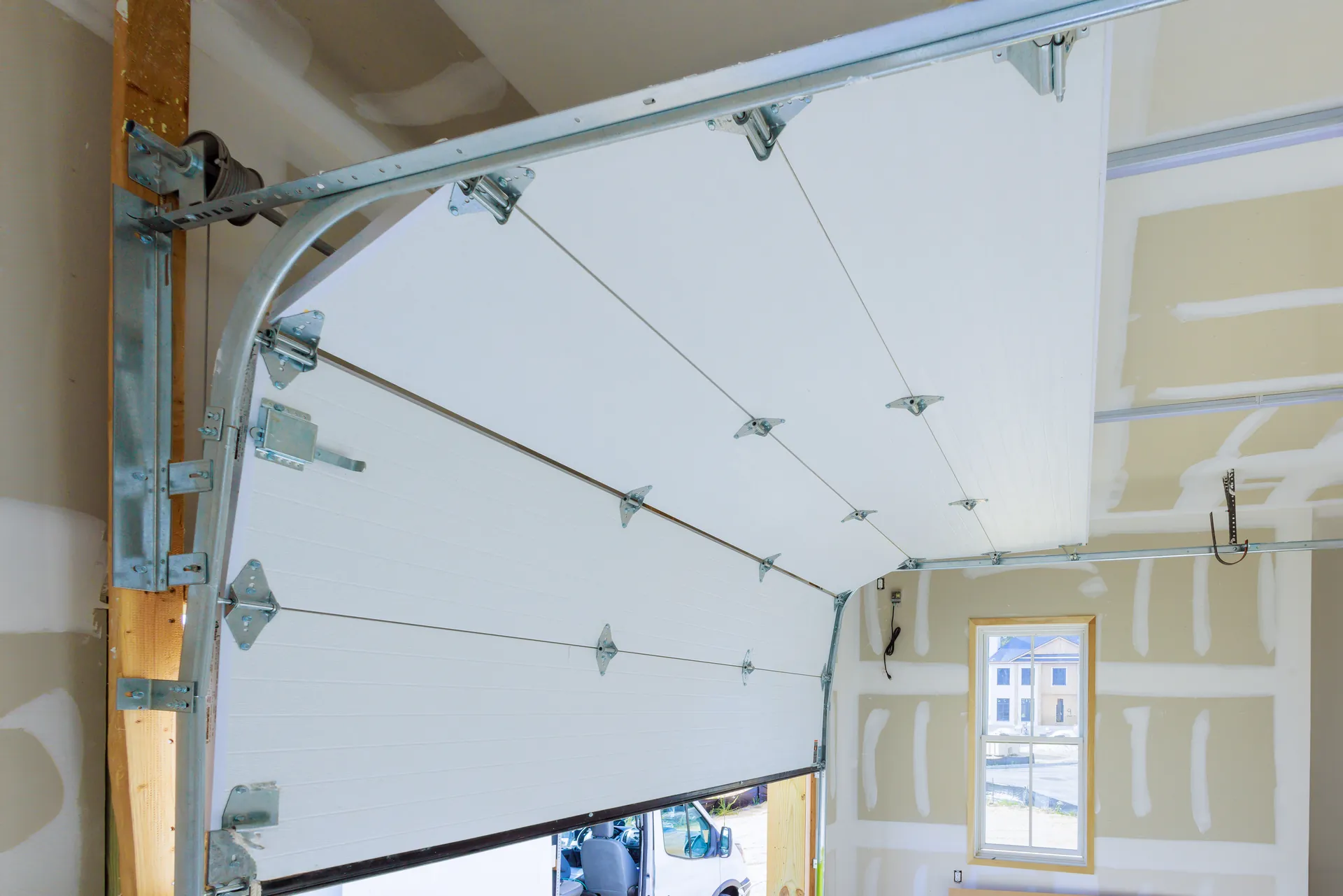
The signature Whittier fault. A sectional door has been installed into a rough opening that is neither square nor plumb, and the vertical track has been shimmed to follow the jamb rather than set true to the horizontals. The door then travels along a slightly twisted path: it drags on one side, the rollers on that side wear flat, the top section rubs the header seal, and the opener force setting gets turned up over the years to push through it. We correct the track geometry to the door rather than to the wall, and pack the difference at the jamb where it belongs.
Low headroom in original outbuilding garages
Many of the older detached garages here have very little space between the top of the opening and the rafters, because nobody was allowing for a curved track and a torsion tube in 1925. Doors get installed anyway, often with the spring assembly bodged into a position it was not designed for. There are proper answers to this — low-headroom track with a double horizontal, a front-mounted or rear-mounted torsion conversion depending on which end has the timber to take it — and we would rather fit the right one than force a standard kit into six inches of clearance.
Spring anchors bolted to century-old framing
A torsion spring transmits its entire reaction load into whatever the centre bearing plate is bolted to. In a modern garage that is a purpose-built header. In an older Whittier garage it is frequently a piece of original timber, sometimes dry, sometimes with old fixings still in it, and occasionally with a hairline split running from a previous lag bolt. We check the anchor pad and the timber behind it on every spring job, and where the substrate will not take the load we fit a proper backing plate spanning to sound framing instead of tightening a lag into split wood and hoping.
Damp, corrosion and rot at the bottom of the door
Detached garages at the back of a shaded lot, and hillside garages with a slab that drains toward the opening, both put standing water where the bottom section and the bottom brackets live. Steel bottom sections rust from the inside of the fold outward, the bottom fixture that carries the full cable load corrodes at its fasteners, and timber jambs soften enough that the track lags lose their grip. It rarely announces itself. We check bottom fixtures, cable ends and jamb fixings as a matter of course on any Whittier visit, because this is the failure that turns into a dropped door.
Whittier garage door FAQs
- Our technicians are distributed across the service area rather than setting off from one place, so when you call we look at which of them is nearest to you at that moment and give you a real window built on that and on the traffic. SR-72, the 605 and the 60 all feed into the city, and which of them is moving is part of the answer. You will get a message when the technician sets off. If the honest figure is longer than you were hoping, we will tell you that instead of guessing low.
- It changes the electrical side and the access side. Detached garages usually have power run out to them later, sometimes in surface conduit, and the low-voltage sensor wiring is often stapled along a sill plate where damp gets at it — so faults there look like opener faults and are not. For access, tell us when you book whether the driveway takes a van all the way to the door or whether we will be carrying sections down it. It makes no difference to the price and a lot of difference to how the visit runs.
- Usually not. In older Whittier garages the far more common cause is an opening that has gone out of square, so the door is being asked to run along a path that is slightly twisted. That shows up as one corner touching down first, an uneven gap at the floor, and rollers that wear flat on one side only. It is fixable by setting the tracks true and shimming to the jamb, and it does not normally need a new door.
- You are not limited to a flat modern panel. Insulated steel doors are made in carriage-house and recessed-panel styles with convincing woodgrain finishes, and they weigh a fraction of what a real timber door of the same size does — which matters a great deal when the spring anchor is going into old framing. Solid timber is possible where the structure supports it. We will measure the opening, work out what it can carry, and show you what actually fits before you choose on appearance alone.
- Yes. We come out, diagnose the fault, show you the component that has failed, and write down what the work involves in parts and labour before anything is dismantled. If you would rather not proceed, that is the end of it — no call-out fee and no pressure. We would rather you had an accurate picture than a fast yes.
Request service
Fast callback during business hours. For urgent safety issues, call now.