Downey Garage Door Repair
Garage Door Repair in Montebello, CA
Technicians working across Montebello and Los Angeles County — not dispatched from one address. Local routes via I-5 and SR-60.
Open 24/7 for emergencies
Free diagnostic estimate on every call-out
Ring us and the first thing the dispatcher does is find out who is closest to you right now. Our technicians are spread across the service area through the day rather than sitting somewhere waiting to be sent out, so the arrival window you are quoted comes from where the nearest van actually is and what the roads are doing between there and you. Behind that there is a real shop at 8232 Nance St in Downey with a parts room, a spring rack and stock on the shelves, which is why the van that turns up is carrying components rather than a catalogue.
The second thing we ask is more unusual, and it is specific to this city. We need to know whether your garage sits in Montebello's flat lowland or in the part of the city built into hill terrain, because those two halves are not variations on one job. They are two different jobs with different hardware, different geometry and different failure patterns, and a technician who assumes gets it wrong roughly half the time. Two minutes on the phone settles it, and it decides what goes on the van.
One city, two garages: what the flat half and the hill half each need
Montebello sits in Los Angeles County with a population of around 62,968, crossed by I-5 and served on its northern side by SR-60. What makes it unusual for this trade has nothing to do with either freeway. It is that the city is genuinely split by its own ground: a broad flat lowland section on one side and real hill terrain on the other, with the housing following the terrain in sequence. The flat ground was built out first, in an earlier era of residential construction. The higher ground came later, once building on a grade was routine and plans existed to make use of it. The result is two distinct populations of garages inside one set of city limits, and the boundary between them is topographic rather than administrative — you cannot draw it from a map of street names.
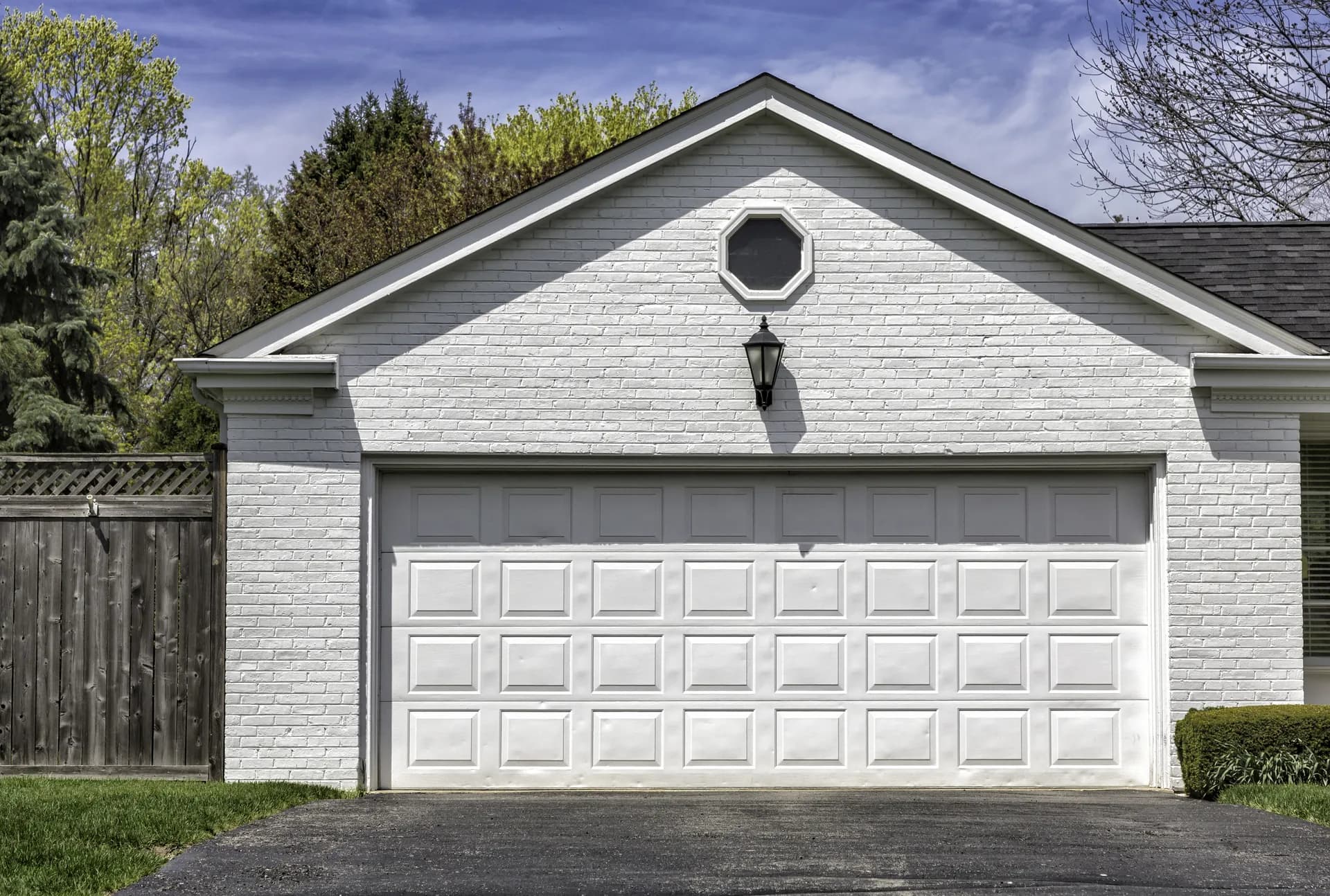
Take the flat half first, because it is the more familiar of the two and the one most technicians default to. Here the garage is typically street-facing and set on a level pad, single or double width, attached to the side of the house or standing detached behind it. The driveway meets the apron at more or less the same height as the slab. The ceiling above the door is often open to the rafters or to a shallow attic, which means headroom above the opening is conventional and there is room for a standard torsion assembly, a standard track radius and an opener rail hung off the framing without a fight. The openings themselves are frequently older than the doors in them and were framed for the vehicles of their day, so they run narrow by modern standards, and whatever is hanging in them now was chosen by an owner rather than a builder.
The hill half is a different specification from the first measurement onward. The driveway climbs, falls or steps to reach the garage rather than running flat to it. The garage is often tucked under living space, so the ceiling above the opening is a structural floor with a room on top of it, not an open rafter bay — which means headroom is limited and, more importantly, fixed, because you cannot gain any of it back. Split-level plans put the garage slab a half-level away from the rest of the house. The pad the door lands on frequently is not level across the full width of the opening, since the transition from a graded drive to a finished slab has to be absorbed somewhere. Backroom into the garage can be cut short by the building footprint, and the approach constrains where a van can stand and where a door can be laid out and assembled on the ground.
So the same phone call produces two different vans, and that is why we ask rather than assume. What we want to know before loading is simple enough to answer standing in your kitchen: does the driveway run level to the garage or does it rise, fall or step; is there a room directly above the garage or is the ceiling open; is the garage floor at the same level as the rest of the house; roughly how much space is there between the top of the door opening and the ceiling; and is the door single or double width. Five answers, and the low-headroom track kits, the alternative spring hardware and the shorter-radius components either go on the van or stay on the shelf. Guessing costs you a return visit, and it is entirely avoidable.
What we fix most often in Montebello
Hardware specified for the wrong half of the city
The signature Montebello fault, and it is rarely the current owner's doing. A door gets replaced or repaired by somebody who priced the job from a width and a height, brought a standard kit, and then made it fit. On a tuck-under garage with a floor above it, that means a full-radius track forced into headroom that never had room for it, packers under the horizontal track to steal the last inch, and a torsion shaft mounted higher than the hardware was designed to sit. On a level flat-half garage it shows up in reverse, as a low-headroom or double-track arrangement fitted where there was no need for the compromise, adding friction and parts that will wear. Both run, which is why nobody questions them, and both wear out early in a way that looks like bad luck.
A pad that is not level across the opening
On the hill side of the city this is common enough that we check it before we discuss anything else. The door is straight and the floor is not, so the bottom section meets the slab at one corner first and leaves a tapering gap at the other end. What follows is predictable: the opener reads the early contact as an obstruction and reverses, or the down limit gets wound further to close the gap and the door is driven into the high corner every cycle, loading one bottom fixture and one cable far harder than the other. The same complaint on the flat half of the city usually means something completely different — a settled slab, a failed hinge, a bent track section — which is exactly why we measure the floor with a level and a straightedge rather than judge the door by eye.
Low headroom that is a floor, not a ceiling
When there is a room above the garage, the space between the header and the underside of that floor is the space you have permanently. It cannot be found later, and it decides the spring arrangement, the track radius, the roller stem length, the top fixture and where the opener rail can hang. We routinely find doors in these garages running on hardware that is fighting the building — top rollers riding the very end of their travel, a rail packed down hard against a joist, an opener head bolted where somebody could reach rather than where the load is. It is fixable with the correct low-headroom components, but only if the person quoting the job knew the constraint existed before they arrived.
Access that changes how the work has to be staged
A garage door repair needs somewhere to stand, somewhere to lay sections out, and somewhere to put the old hardware. On the flat half of the city that is the driveway, and it is rarely a question. On a sloped or stepped approach it becomes part of the plan: the working platform is not level, sections cannot simply be laid flat on the drive, and the space a van needs is not always immediately in front of the door. This does not change how long it takes us to reach you — that depends only on who is nearest when you call. It changes how the job itself is set up once we are there, and it is one of the things worth mentioning on the phone so nobody is improvising on your driveway.
Montebello garage door FAQs
- It depends entirely on which technician is closest to you at the moment you ring, and that is the only honest basis for an answer. Our people work across the service area rather than setting out from one building, so whoever takes your call checks where the nearest van is and quotes a window from that and from the traffic between you. If the truthful window is longer than you were hoping for, you will be told the longer number rather than a comfortable one.
- Because in this city those two answers decide the parts. A garage tucked under a room, reached by a drive that climbs or steps, needs low-headroom track, particular spring hardware and shorter-radius components. A level, street-facing garage with open rafters above the opening takes conventional gear. Both are Montebello, often within a short distance of each other, and the difference does not show up in an address. Two minutes of questions is what lets us bring the right hardware the first time instead of coming back with it.
- Possibly, and it depends on whether their garage is built the way yours is. If you are both on the flat side with level pads and open ceilings, their experience is a reasonable guide. If one of you is in a tuck-under or split-level garage on a graded approach, it is not — the identical symptom can be a five-minute adjustment in one and a hardware change in the other. Tell us what you know about their repair anyway. It is useful context, it just is not a diagnosis.
- We can usually narrow it to a small number of likely causes and tell you which of them are safe to leave until morning, and after the terrain questions we can generally tell you which hardware family your garage falls into. What we will not do is put a specification on it before somebody has measured the headroom and weighed the door, because the two halves of this city carry genuinely different door weights and different constraints. Anything more precise than that over the phone would be a guess dressed up as a quote.
- We are licensed, insured and bonded, and those details go in writing before any work starts if you want them for your records. There is no call-out charge for the diagnosis: a technician comes out, finds the fault, shows you the failed component in your hand rather than describing it, and leaves you a written estimate with parts and labour separated. Decline it and that is genuinely the end of it, with nothing owed.
Request service
Fast callback during business hours. For urgent safety issues, call now.