Downey Garage Door Repair
Commercial Garage Door Repair — Downey & Surrounding Cities
Minimize downtime with prioritized commercial dispatch and documented safety practices.
Open 24/7 for emergencies
Free diagnostic estimate on every call-out
How commercial doors differ from residential ones
The obvious difference is size, but the consequential one is duty cycle. A residential door might complete four cycles a day; a busy loading bay can complete forty or more. Since spring life, roller life and operator life are all measured in cycles rather than years, a commercial door reaches a wear point ten times faster than the identical residential component would, and maintenance intervals have to be set on that basis rather than on the calendar.
Construction differs accordingly. Commercial sectional doors use heavier gauge steel, three-inch track with correspondingly larger rollers, heavier hinges and end stiles, and horizontal struts across the back of each section. Springs are specified for high cycle counts — twenty-five thousand, fifty thousand, or considerably more — and the shaft, drums and bearings are sized to match. Fitting residential-grade parts into a commercial assembly is a false economy that shows up as a repeat failure within months.
Rolling steel doors are a different mechanism altogether. Instead of hinged sections riding a track into the ceiling, interlocking steel slats coil around a barrel above the opening, with the counterbalance springs housed inside that barrel. There is no ceiling track and no rail, which is why they suit bays with no overhead clearance, and the failure modes are correspondingly different: slat damage, guide wear, barrel spring tension loss, and bottom bar and astragal damage from impact.
Operators are heavier and are configured for the mounting rather than for the ceiling. Trolley operators run on a rail like a residential unit but at higher duty ratings. Hoist and jackshaft operators mount at the side and drive the shaft or barrel directly. Most commercial operators are also wired to three-button control stations and are configured for constant-pressure closing rather than momentary contact, which is a safety configuration rather than a convenience one.
Door types and assemblies supported
- Rolling steel service doors, slat and curtain, with barrel-mounted counterbalance
- Rolling sheet doors on lighter-duty openings
- Commercial sectional doors on three-inch track with strut-reinforced sections
- High-cycle spring assemblies and heavy-duty shafts, drums and bearings
- Trolley, hoist and jackshaft operators with three-button control stations
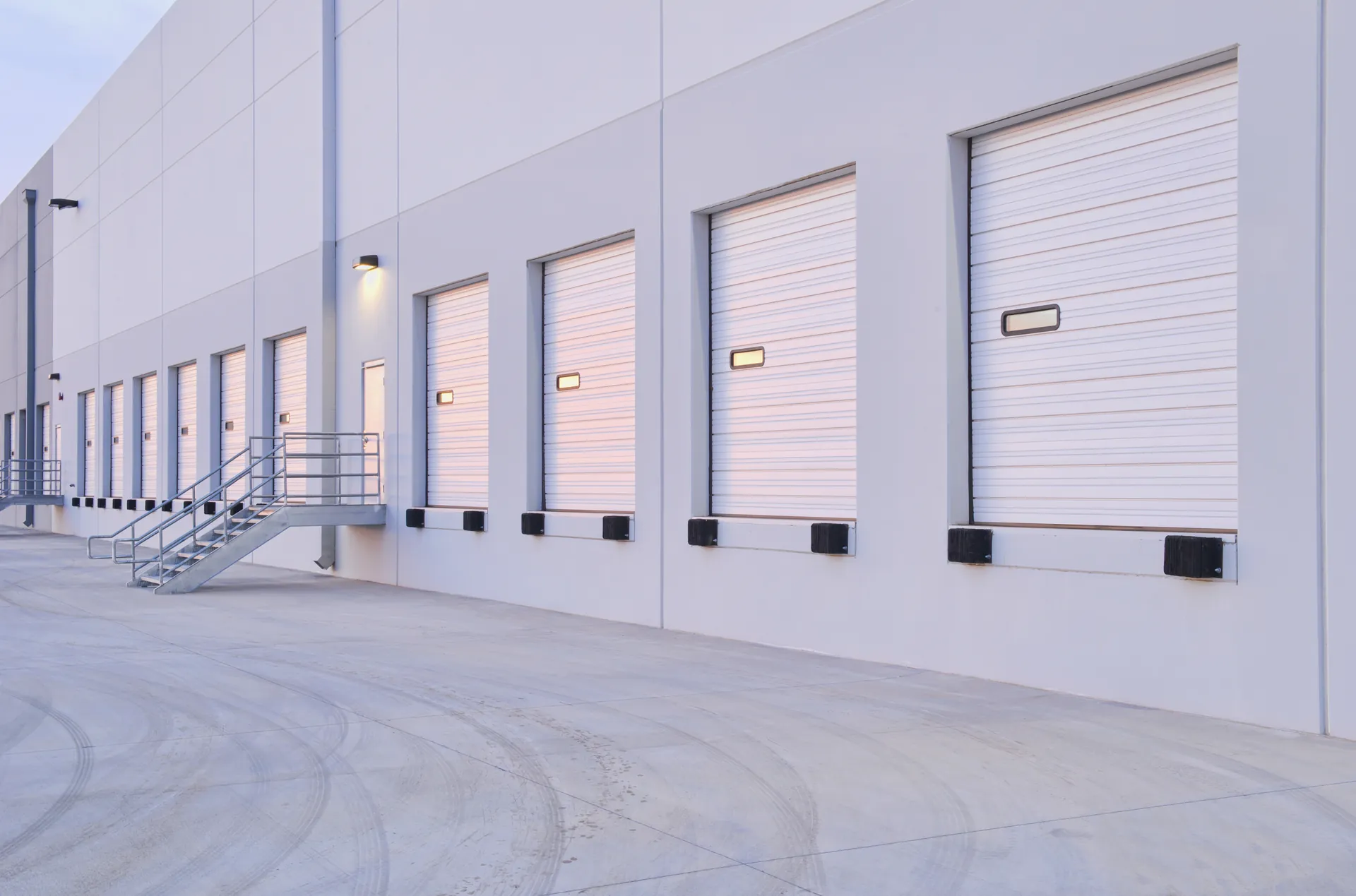
- Loading dock doors, including bumper and guide damage from vehicle contact
- Fire-rated rolling assemblies, where certification for the work is confirmed on site
- High-lift and vertical-lift track configurations in high-clearance bays
What actually fails on a commercial door
Impact leads the list, and it is the difference that most distinguishes commercial from residential work. Forklifts, delivery vehicles and pallet jacks strike guides, bottom bars, slats and track, and the resulting damage is mechanical and immediate rather than gradual. On a rolling steel door a struck bottom bar can bind in the guides; on a sectional door a struck section usually needs replacing rather than repairing.
Cycle-driven wear comes second. Springs reach their rated cycle count far sooner than anyone expects, and because commercial springs are larger and store more energy, their failure is more consequential. Bearings, drums and shafts wear faster under the same cycle counts, and on rolling doors the barrel springs lose tension gradually, which shows as a curtain that gets progressively harder for the operator to lift.
Operator and control failures come third and are frequently the ones that stop the business. Motor contactors and limit switches on commercial operators are electromechanical and wear at a rate proportional to duty. Control station wiring gets damaged in a working environment, and safety devices — photo-eyes across the opening, and the safety edge along the bottom bar — get knocked out of alignment or damaged outright.
Environmental deterioration comes fourth and is easy to defer until it is not. Corrosion in a wash-down area, grit packing into guides and bearings on a dusty site, and weather seals that have failed enough to let water into the bay all progress quietly, and they compound the wear from everything else.
How a commercial service call runs
- 1
Scope and access agreed before arrival
Site access, gate and dock procedures, the bay in question and any contractor requirements are established when the call is booked. On managed properties this often means coordinating with facilities rather than the tenant, and getting it settled first avoids a technician arriving at a bay they cannot reach.
- 2
Make the opening safe
The first action on arrival is to establish whether the bay can remain in use. Where a door is unsafe or unstable, the opening is secured and the bay taken out of service before diagnosis begins, and whoever is responsible for the site is told directly rather than left to infer it.
- 3
Isolate before working on the operator
Commercial operators are hard-wired and frequently three-phase. Power is isolated and secured before any work on the drive or controls, and where the site operates a lockout and tagout programme, the technician works to it and documents accordingly.
- 4
Diagnose the whole assembly
Counterbalance, curtain or sections, guides or track, bottom bar or bottom section, operator, controls and safety devices are all assessed rather than just the reported fault. On a high-duty door the reported symptom is usually one of several components at a similar point in their service life.
- 5
Written scope before work proceeds
You receive a written, itemised scope covering parts, labour and any return visit needed for ordered components. Where a temporary measure will keep the bay operating until a part arrives, that is offered as an explicit option with its limitations stated.
- 6
Repair, then verify under load
After the repair the door is cycled repeatedly rather than once, because intermittent faults on high-duty doors do not show on a single operation. Counterbalance, limits, operator force, photo-eyes and the safety edge are all verified, and the work is documented for the site's records.
Safety systems and documentation on commercial doors
Commercial doors carry entrapment protection that residential doors do not. A safety edge — a pressure-sensitive strip along the bottom bar — reverses the door on contact, and photo-eyes across the opening reverse it on beam interruption. Both are damaged routinely in working environments, and a door operating with a defeated safety edge is a serious exposure rather than a snag. We test both on every visit and report them whether or not they are what we were called for.
Control configuration matters as much as the devices. Many commercial installations are configured so that closing requires constant pressure on the control station, so that an operator has to be watching the opening while the door comes down. Where that configuration has been bypassed to make the door more convenient, it is worth knowing, because it changes the risk profile of the door significantly.
Fire-rated rolling assemblies are a category of their own. They are held open by a release mechanism designed to drop the curtain when a detector or fusible link triggers, and that mechanism has to be tested and reset by someone qualified to do it. We will confirm on site what we are certified to carry out on your specific assembly rather than assume, and we will say plainly where a specialist is required.
Documentation is part of the work rather than an afterthought. Findings, parts fitted, safety device test results and any recommendations are recorded so your facilities team has a maintenance history for the door, which is what makes it possible to plan replacements rather than react to failures.
Planned maintenance for high-duty doors
The economics of maintenance are different on a commercial door because the cost of the failure is different. A residential door that fails is an inconvenience. A dock door that fails takes a bay out of service, and for most operations that cost exceeds the entire annual maintenance cost of the door within a day or two.
A planned programme sets intervals from measured cycle counts rather than the calendar, tracks each door's spring life against its rating so replacement is scheduled rather than awaited, and inspects the components whose failure causes unplanned downtime: cables and springs, guides and track, bottom bar and safety edge, and operator contactors and limit switches.
The other benefit is procurement time. Commercial parts — high-cycle springs in specific ratings, slats for a particular curtain profile, operator boards — are frequently not stock items, and the lead time is what turns a repair into an outage. Knowing a door is approaching the end of its spring life lets the part be on the shelf before it is needed rather than ordered after the bay has stopped.
Frequently asked questions
- Common high-cycle springs, cables, rollers, bearings and hardware travel on the truck, and operator drive components for mainstream commercial ranges are stocked or sourced. Specific slat profiles, non-standard spring ratings and obsolete operator boards are order items, and lead times are stated at the scope rather than after.
- Commercial calls where a bay, an exit route or a fire lane is blocked are prioritised over routine bookings, and we run a 24/7 line. The window you are given reflects which technician is closest at that moment, and you are told in the same call whether the probable parts are already loaded.
- Yes, and on many commercial jobs that is the sensible approach, since taking a bay out of service during trading hours costs more than the work. Arrange it when booking so access, isolation and any site induction requirements are settled in advance.
- Regularly. Scope, access arrangements, isolation procedures and documentation can all be coordinated with facilities rather than the tenant, and written scopes and completion records are provided in a form that suits a maintenance file.
- They share almost no components. A rolling steel door has interlocking slats coiling around a barrel with the springs inside it, and fails at the slats, guides, bottom bar and barrel tension. A sectional door has hinged panels on track with an external counterbalance, and fails at springs, cables, rollers and sections. Diagnosis, parts and skills differ throughout.
- Yes. The safety edge is the primary entrapment protection on most commercial doors, and a door closing without it working is closing without anything to stop it on contact. It should be treated as a fault that takes the automatic close out of service until it is repaired, not as a cosmetic problem.
🚐 Need a truck rolling today?
Request a quote / bid
Commercial scope, multiple bays, or property managers—send details for a written bid.
Request service
Fast callback during business hours. For urgent safety issues, call now.
Related pages
Request service
Fast callback during business hours. For urgent safety issues, call now.