Downey Garage Door Repair
Garage Door Replacement — Downey & Surrounding Cities
When repair isn’t economical, we help you pick a door that fits your home, budget, and daily use.
Open 24/7 for emergencies
Free diagnostic estimate on every call-out
The question replacement actually answers
Almost everything on a garage door is a serviceable component. Springs, cables, rollers, hinges, track sections, weather seals and the operator are all designed to be replaced periodically, and the fact that one of them has failed says nothing about whether the door needs replacing. Replacement becomes the right answer when the panels themselves — the only part that is not routinely serviceable — can no longer do their job.
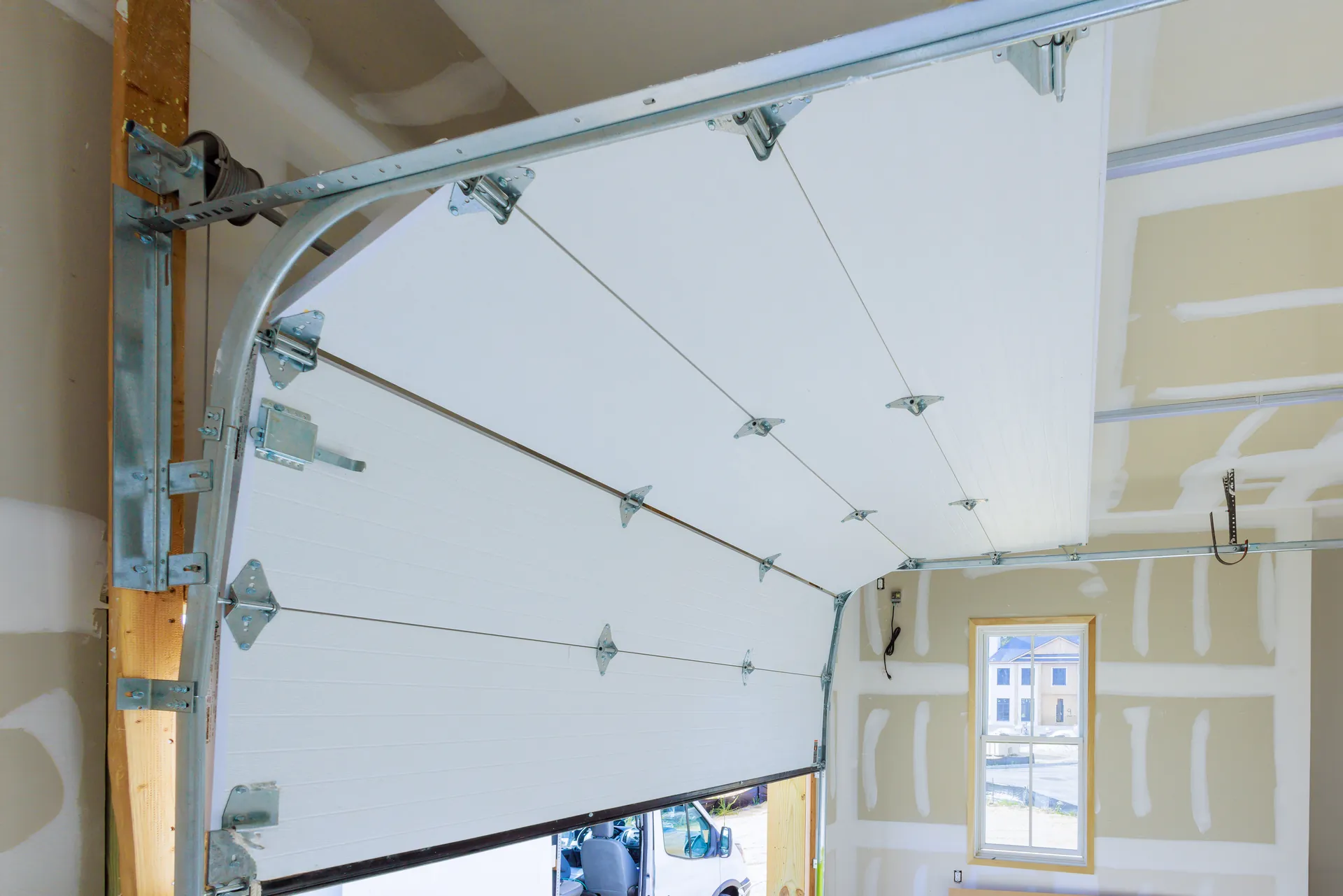
A door panel does two jobs at once. It spans the opening as a weather and security barrier, and it acts as a structural member carrying hinges, rollers and, on the bottom section, the entire cable load through the bottom brackets. When a section bows, delaminates or loses its ability to hold a fastener in the end stile, it fails the second job first. From that point every repair is bolting good hardware onto something that cannot hold it.
The second legitimate trigger is accumulation. A door where the springs, the rollers, the cables and the operator are all at or near end of life at the same time is not a door with four faults; it is a door that has reached the end of a service cycle. When the sum of those repairs approaches the value of a new assembly with a new warranty and a spring system correctly sized from the outset, replacement is the more rational choice — and we will lay that comparison out in writing rather than assert it.
The third is capability. A door that predates modern entrapment protection, or one whose construction cannot support the insulation, quietness or wind-load rating you now need, is not defective so much as unsuited. That is a legitimate reason to replace and a different conversation from a failure.
Signals that point toward replacement rather than repair
- Sections visibly bowed or twisted when the door is closed and viewed along its face
- Hinge or bracket fasteners that no longer hold in the end stiles, or repaired tear-out
- Delaminated insulation core, or skins separating from the core on a sandwich panel
- Rust perforation at the bottom section where water has stood against the astragal retainer
- Rot or splitting on a wood door that has progressed past the surface
- Multiple systems at end of life simultaneously — springs, rollers, cables and opener
- A door with no photo-eye entrapment protection and no sound way to add it
- Panel sections discontinued and unavailable, on a door with damage to more than one section
Weighing the two options honestly
- Repairing keeps a door you already know, and the components fitted are new even if the door is not.
- Repair is usually the right answer for a single failed system on a door whose panels are sound, however old that door is.
- Repair preserves a size, style or finish that would be expensive or impossible to match in a new door.
- Replacing resets every wearing component at once, and the spring system is sized to the new door's measured weight from the start.
- Replacing is the only route to insulation, rigidity, quietness or a wind-load rating the existing construction cannot deliver.
- Replacing ends the availability problem — no more sourcing sections and hardware for a discontinued model.
How a replacement is scoped
- 1
Assess the existing door honestly
The first job on site is to establish whether the door genuinely needs replacing. Panels are checked for bow, delamination, fastener tear-out and corrosion, and the balance is tested. If the answer is that a repair would serve you properly, that is what you will be told, and you will get a written estimate for the repair instead.
- 2
Measure the opening as a new installation
Width, height, sideroom, headroom and backroom are measured to the finished opening, and the ceiling is checked for obstructions. Existing dimensions are never assumed from the old door, because openings are frequently modified after they are built and the old door may itself have been a compromise.
- 3
Check the structure behind the door
Jambs and header are checked for rot, splitting, plumb and square, and the existing track mounting is inspected. Structural remedial work is identified and priced at the estimate rather than discovered on the day, since track set into a jamb that cannot hold a lag is track that will move.
- 4
Specify construction to the use, not the catalogue
Gauge, layer count, core material and window configuration are chosen against how the space is used and what adjoins it. A garage sharing a wall with a bedroom, or serving as a workshop, has different requirements from a detached bay used for storage.
- 5
Written, itemised estimate
You receive a free written estimate breaking out the door, track and radius, spring system, operator if included, weatherstripping, disposal and labour, with any structural work listed separately. Where both repair and replacement are viable, you get an estimate for each so you can compare them directly.
- 6
Installation and commissioning
On the day, the old assembly is removed, the opening prepared, new track set plumb and square, and the door built up section by section. The finished door is weighed, the springs specified from that weight, and the balance verified by hand before the operator is connected and both safety systems tested.
What to specify, and what it changes
Construction layers matter more than most other choices. A triple-layer sandwich panel is markedly stiffer than a single skin, and that stiffness is what keeps a wide door from bowing and keeps end stiles holding their hinge fasteners over years of cycling. On a double-wide opening it is the specification that most affects how the door ages, quite separately from any insulation benefit.
The core material is the second decision. A polyurethane core is foamed in place and bonds to the skins, contributing structural rigidity as well as insulation value; a polystyrene board core is fitted as a separate panel and contributes less of both. Where the garage adjoins living space, the practical effect people notice first is not temperature but how much quieter the door is in operation.
Hardware grade is the third, and it is where quotes differ invisibly. Sealed nylon rollers with a decent bearing count run quieter and last longer than plain steel; heavier gauge hinges and reinforced end stiles hold better on wide doors; and high-cycle springs are a sensible specification wherever the door runs more than a couple of times a day. None of these are visible in a photograph of the finished door, which is precisely why they are worth asking about.
Finally, the operator. If it is being replaced at the same time, drive type and mounting are worth deciding deliberately rather than by default, and the new door's weight is the number that determines what is adequate rather than what is marginal.
Frequently asked questions
- Opening size, construction layers and core material, window configuration, hardware grade, whether a wind-load rating is required, whether the operator is being replaced, and any structural work needed to the jambs or header. Every one of those is itemised on your written estimate so you can see what each choice contributes.
- Ask for the repair estimate alongside the replacement estimate. Where a repair would genuinely serve you, we will say so and quote it, and where it would not, the reason will be a specific structural finding — a bowed section, torn-out fasteners, a delaminated core — that you can look at yourself.
- Usually, if the operator is mechanically sound and its capacity suits what the new door weighs. That rating gets checked rather than assumed, because a heavier insulated door on an operator specified for a light single-layer one will strip its drive gear well before it should.
- The opening is only open during the installation itself, which for a standard single or double door is a same-day job. There is no period where you are left without a door overnight unless a structural repair to the header or jambs requires it, and that would be flagged at the estimate.
- Almost always, though the door itself is only part of it. A stiffer multi-layer panel transmits less noise, but the larger contributors are new sealed rollers, correctly sized springs and a properly aligned track. A new door installed on old hardware would be much less of an improvement than people expect.
- No, though matching is worth thinking about before you decide. Sections and finishes vary between production runs, so an exact match to an older neighbouring door is not always achievable. If appearance across the frontage matters to you, that is a reason to consider doing both at once rather than a requirement.
🚐 Need a truck rolling today?
Related pages
Request service
Fast callback during business hours. For urgent safety issues, call now.