Downey Garage Door Repair
Garage Door Repair in Downey — A Real Nance St Parts Shop, Not a Call Centre
Technicians working across Downey and Los Angeles County — not dispatched from one address. Local routes via I-5 and I-605 and I-105.
Open 24/7 for emergencies
Free diagnostic estimate on every call-out
Our shop is at 8232 Nance St, Downey 90241. That is not a mailing address or a virtual office — it is a working parts room, where the torsion springs are racked by wire size and drum, where cable, drums, bearings, bottom fixtures and opener kits are held in stock, and where somebody can physically put their hand on the part your door needs rather than ordering it in and calling you back on Thursday.
That matters more than most people realise, and it is worth being precise about why. It is not an argument about how fast anybody can reach you: our technicians work across the whole service area rather than starting the day from this address, so when you call, the dispatcher looks at who is genuinely nearest to you at that moment and quotes from that. What the shop changes is the other half of the job — whether the van turning into your driveway is carrying the right spring for your door. Because the trucks are stocked out of our own inventory rather than from a distributor run, the answer is usually yes, and that is what decides whether this is finished today or booked in again for next week.
There is one more thing worth putting at the top, because it runs through every page on this site. Downey is not an assortment of unrelated houses. It is a city that went up quickly, in a particular couple of decades, to a fairly narrow set of drawings, and has been modernised one component at a time in the sixty and seventy years since. The doors on the front of these garages have very largely been replaced. The hardware holding them up frequently has not. If you take a single idea away from this page, take that one: the fault we attend most often in this city is not a worn-out part. It is a mismatch between the door somebody hung and the system that is supposed to be carrying it.
What Downey's housing stock means for your garage door
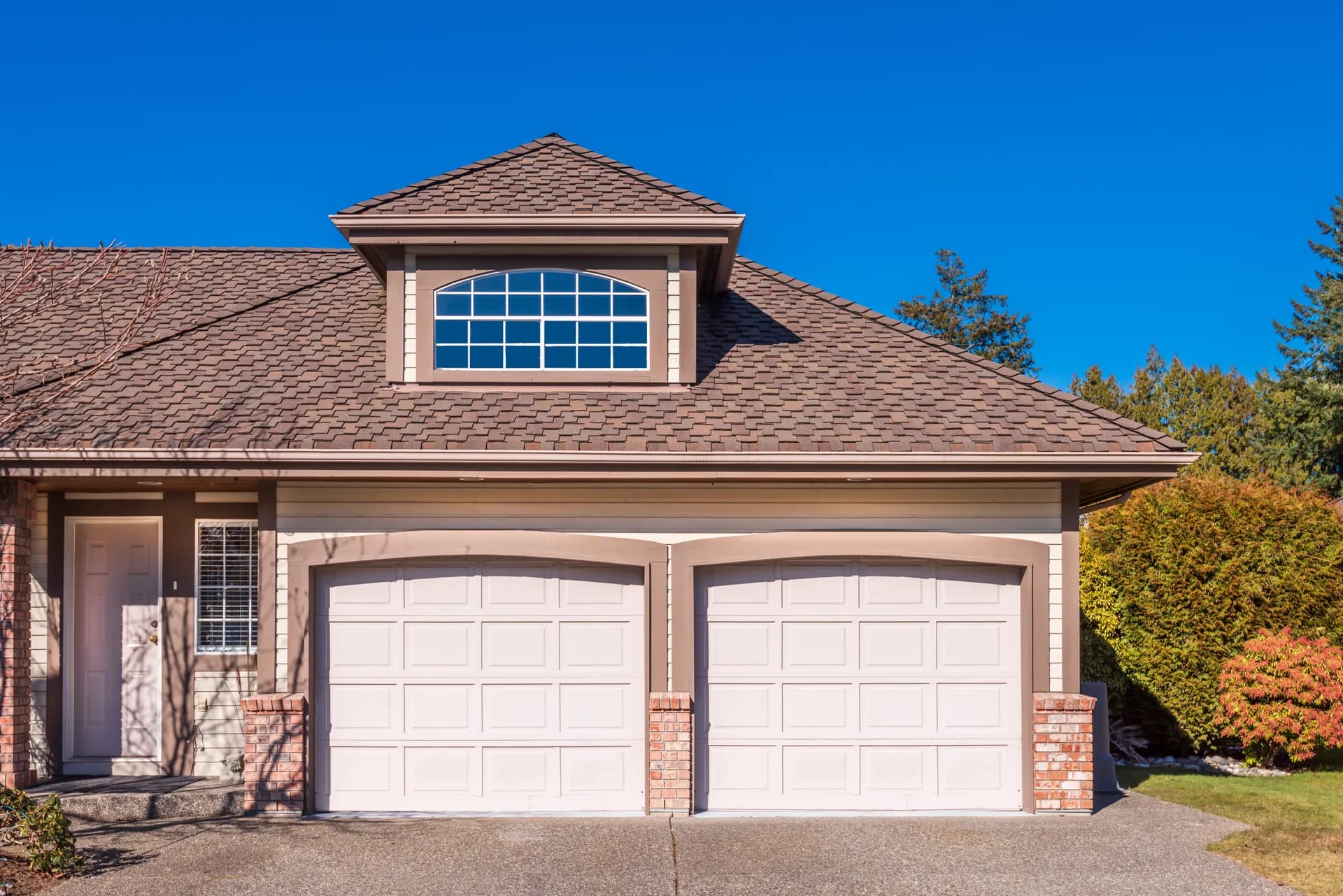
Downey grew up in the two decades after the Second World War, when the aerospace plants along the Rio Hondo were hiring and tract housing went up across the old ranch land at speed. That history is still sitting in your garage. The overwhelming majority of homes here are single-storey, single-family houses from the 1940s through the 1960s, with the garage attached and facing the street. That arrangement decides more than it looks like it does. The door is on the front elevation, so it is both a mechanism and a large part of what the house looks like. There is no storey above the garage, so the opener hangs from ceiling framing with only a shallow roof space over it. And because the garage is attached, whatever the door does — mechanically, thermally and in terms of security — it does to the house rather than to an outbuilding at the back of the lot.
Those original builds came with one-piece tilt-up wood doors or early sectional wood doors, and almost none of them are still original. What we mostly find is a second- or third-generation steel sectional door hung on hardware that was sized for something lighter. That mismatch is the single most common root cause we see in Downey: springs rated for a door that was replaced two owners ago, rollers worn oval, and a bottom bracket carrying more weight than it was specified for.
It is worth being clear about why reusing a spring is such a consequential shortcut, because from the driveway it looks like thrift rather than a mistake. A torsion spring is not a general-purpose component that stretches to fit. It is wound to deliver a specific torque per turn, and that figure is set by the wire diameter, the inside diameter of the coil and the length of the body. Change the door and you change the load; leave the spring and the torque stays exactly where it was. The system then spends every cycle of its life either lifting more than it was wound for or holding back more than it should, and everything downstream of it — cables, drums, bearings, the bottom fixtures, the opener's drive gear — absorbs the difference. Nothing announces itself on the day. It arrives a year or two later as a component that failed for no apparent reason.
The second pattern is width. A great many Downey garages were built for one car and later opened up to a double, or built as a double at 16 feet when 16-foot doors were still hung on extension springs. A 16-foot door is heavy enough that spring failure stops being an inconvenience and starts being a hazard, which is why we will not leave a Downey job with a single spring on a double-wide door even if that is what was there when we arrived. Width also puts a demand on the parts nobody looks at. The torsion tube spanning a sixteen-foot opening has to carry the whole counterbalance torque from wherever the springs sit out to both cable drums, and a tube that is adequate across a nine-foot single door is not automatically adequate across sixteen.
Where a garage was widened after the fact, the opening itself becomes part of the assessment rather than a given. Somebody cut the original header, spanned the new width and supported it, and the standard of that work covers a broad range — from a properly sized beam to a pair of members nailed together because they were what was on the truck. A torsion system does not simply hang off that span, it pushes against it: the whole counterbalance torque is resisted at the anchor above the opening, and it is resisted there on every cycle for the rest of the door's life. So on any Downey job that involves winding a spring, what that rebuilt header is made of stops being history and becomes part of the specification. Widened openings also land at whatever width the concrete and the framing allowed rather than at a manufactured door size, which is a thing to establish with a tape before anything is ordered.
Then there is the climate the hardware actually lives in, which is harsher than the weather report suggests. An attached, single-storey Downey garage with a shallow roof space over it gets considerably hotter in the headspace than the shaded side of the house, and the springs, the end bearings and the roller races all live up there in it. Heat thins the grease in an unsealed race and gravity does the rest. At the same time, fine grit works its way in from the street and from the freeway corridors either side of the city, and once abrasive is inside an open bearing race it stops being dirt and starts being a lapping compound. That combination — hot and gritty, year after year — is why steel rollers here get progressively noisier over a couple of summers rather than lasting the way the catalogue implies.
Finally, this is a flat, gridded city with alley access behind a good number of the older blocks. That sounds like trivia until a door comes off its track and the only way to get a replacement section in is down the alley. We know which blocks those are, and it is worth mentioning when you book so the technician arrives at the side of the property he can actually work from.
What we fix most often in Downey
Springs sized for the previous door
The most frequent Downey call. A steel or insulated door went on years ago, the installer reused the existing springs, and the system has been running over-tensioned or under-tensioned ever since. It shows up as a door that flies up, drops fast at the last foot, or will not hold halfway. What makes it deceptive is that a mismatched system still works — it just works with the opener quietly making up the shortfall on every cycle, which is why the part that eventually fails is often not the spring at all but the drive gear, a cable or a bottom fixture. We weigh the door and re-spec the springs to the actual weight rather than matching what came off.
Openers outliving their safety sensors
Chain-drive openers from the 1990s are still working across Downey, and mechanically many of them are fine. What fails is the photo-eye sensors and the logic board. Sun angle on a west-facing Downey driveway blinds one eye in the late afternoon and the door reverses for no visible reason. The tell is that it is not random: it happens in a window of an hour or two, at the same time each day, and moves through the calendar as the sun's elevation changes with the season. Often the fix is realignment, hooding the affected eye, or swapping which side the receiver sits on, rather than a new opener.
Rollers and tracks in a dust-and-heat cycle
Inland Downey summers bake the grease out of steel rollers, and the fine grit that comes off the freeway corridors packs into the bearings. An unsealed race in that environment does not simply run dry, it runs dry with abrasive in it, and the ball path wears until the roller stops rotating freely and begins to skid along the track instead. Doors get progressively louder over a couple of years until a roller seizes and pulls the door out of alignment, and by then the track channel has usually been scored as well. Sealed nylon rollers on the correct stem length, plus a proper track clean-and-align, solve it permanently.
Bottom brackets on wide doors
On 16-foot doors the bottom bracket takes the full cable load — the entire weight of that door arrives at two small stampings, one at each end of the bottom section. On older Downey installs these are frequently the original stamped parts, thinner than what is fitted today and without the tamper-resistant design that keeps the bracket from being unbolted while under tension. They are the component most likely to fail catastrophically, and the failure mode is the bracket tearing at the cable shackle hole rather than the cable parting. We inspect them on every visit whether or not that is what you called about.
Drums, cables and shaft still set up for the door that came off
The quieter half of the reused-hardware problem, and it is the one nobody thinks to look at. Cable drums are sized to a door's travel height, and the cable has to be long enough to wrap that travel with the correct number of dead wraps left on the drum at the bottom of the door. Change the door height, or fit a taller replacement section, and the old drums and cables no longer match what they are being asked to do — the cable runs out of groove, the wraps stack on the flange, or the two sides stop lifting together. On a widened opening we also check the torsion tube itself for diameter, straightness and runout, because a tube that flexes across a sixteen-foot span lets one drum lag the other and racks the door in its tracks.
Downey garage door FAQs
- That depends on which technician is nearest to you at the time you ring, and the person answering the phone can see exactly that. Our technicians are spread across the area we cover rather than waiting at one address to be sent out, so a Downey call is answered with a real arrival window based on where the nearest van actually is and what the traffic on the 5 and the 605 is doing, not on a figure that sounds good. We will text you when the technician sets off, and if the honest answer is that nobody can be with you quickly we will say so rather than book you and hope.
- On a single-car door it can be perfectly correct. On a double-wide door it is a liability, and for two reasons rather than one. The obvious reason is redundancy: when that one spring breaks the entire door weight transfers to the cables and the opener at once. The less obvious reason is that a single spring sits at one point on the torsion tube and has to send its torque along the whole span to reach the far drum, which twists the tube and lets one side of the door lift fractionally before the other. Fitting springs in pairs shares the load and also shortens the torque path. We fit them in pairs on double doors as standard, and we will explain why before doing it, not after.
- Yes. Parts are harder to source than for a modern sectional, and there are cases where a replacement genuinely is the better call — but we will service and rebalance a tilt-up door where it is sound, and we will tell you plainly when it is not worth putting more money into. One thing worth knowing if you still have one: a tilt-up swings out through an arc as it opens, so it needs clear space in front of it that a sectional does not, and that is occasionally the deciding factor when a household's parking has changed since the door went on.
- There is a test you can do in about a minute, and it is the same one we start with. Pull the manual release cord so the opener is out of the way, then raise the door by hand to roughly waist height and let go. A door whose springs suit it will stay more or less where you left it. If it sinks to the floor, the springs are carrying less than the door weighs. If it climbs on its own, they are carrying more. Either result is worth a call, because both states put a load on the opener that it was never meant to carry, and both are usually the signature of a door that was changed while the springs were left alone. Do not do this test if a spring has visibly broken.
- Yes. We diagnose the fault, we physically show you the worn or failed component rather than describing it, and we hand you a written estimate that separates parts from labour before any tool comes out of the van. If you decide not to go ahead there is nothing to pay and no call-out charge, and that holds whether you have decided to think about it, to get another opinion, or simply not to do the work at all. If we find something dangerous while we are there — a frayed cable, a cracked bottom bracket, a coil with a visible gap in it — you will be told about it either way, because that is a safety matter rather than a sales one.
- We do — gate openers, loop detectors and safety photo-eyes. It is the same hardware family and much the same set of safety rules, and a good number of Downey properties have both a gate and a garage door running off equipment of a similar age. Where that is the case it is usually worth having somebody look at the two together on one visit rather than booking them separately, because the faults tend to arrive on a similar schedule.
Request service
Fast callback during business hours. For urgent safety issues, call now.