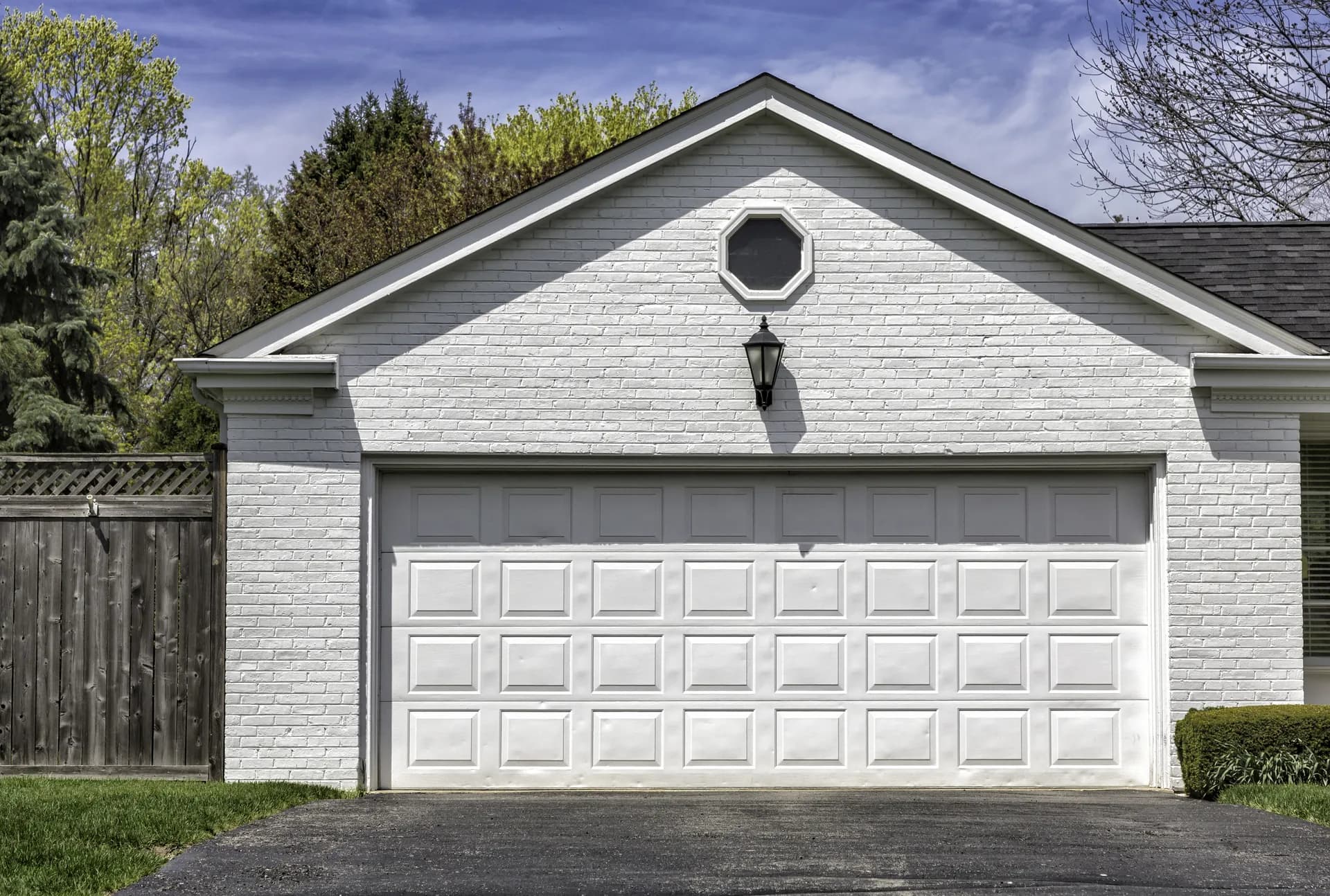
Downey Garage Door Repair
Settled Slabs and Doors That Will Not Sit Square
Technicians working across Carson and Los Angeles County — not dispatched from one address. Local routes via I-405 and I-110 and SR-91.
Open 24/7 for emergencies
Free diagnostic estimate on every call-out
Ring us and the first thing the dispatcher establishes is which of our technicians is closest to your address at that moment. Our people work spread across the service area through the day rather than setting out from one building, so the van you get is the nearest one, and the window you are quoted is built from where that van actually is and from what the 405, the 110 and the 91 are doing at the time. Standing behind the vans is a working shop at 8232 Nance St in Downey with a stocked parts room and a rack of springs in it. That matters to you in exactly one respect: the components fitted to your door came off our own shelves rather than being ordered in after somebody had looked at the job. We are licensed, insured and bonded, and the diagnostic visit carries no charge.
What makes the work here its own thing is the ground. Carson sits low and flat, on terrain of the kind that is made and reclaimed rather than original, and ground like that keeps moving long after the concrete poured on top of it has cured. It moves slowly, it moves by different amounts in different places, and it moves by margins nobody notices standing on the slab. A garage door notices. It is a precision assembly bolted to a building that is not staying still, and it is usually the first part of a house to report, in a strip of daylight along one corner, that the floor is no longer level.
Low, made ground, slow settlement, and a door that has to stay square
Low ground that has been built up, filled and levelled behaves differently under a building than original soil does. It consolidates. The material compacts under the weight of what has been put on it and under its own weight, and it does so unevenly, because the depth and the composition of the fill are not identical from one end of a lot to the other. The result over decades is differential settlement: not a building sinking, but different parts of a building coming to rest at very slightly different levels. This is a normal and well-documented characteristic of terrain of this kind, and on most of a house it is invisible — a door inside that has started to catch, a hairline in the plaster, a tile that has gone hollow. On a garage door it is not invisible at all, because a garage door is the one component in the house whose whole function depends on two vertical planes staying parallel and one horizontal line staying level. Half a degree is nothing to a wall. To a fourteen-foot door it is a visible fault.
The first place it shows is the floor line. A bottom seal is a compressible strip that is supposed to meet the slab evenly along its full width, and it has only a limited amount of squash in it. If the slab has come to rest a fraction lower at one end of the opening than the other, the seal touches down at the high end while the low end is still short of the concrete, and the door has no way to keep travelling because it has already landed. So there is daylight at one corner and a compressed, hard-worn seal at the other. What almost everybody does next is buy a thicker seal, and it does work for a season — a taller bulb has more travel to give away — but it is being asked to absorb a level error rather than to seal a flat joint, so it takes an uneven set, wears through at the loaded end and the gap returns. The seal is not the fault. The seal is where the fault is being displayed.
The second place it shows is squareness. When the slab and the surrounding framing have moved by different amounts, the opening itself deforms slightly — one jamb ends up marginally taller than the other, or the header is no longer perpendicular to both of them, and the two diagonals across the opening stop being equal. Vertical tracks fixed to those jambs are then no longer parallel to one another. The door is a rigid width and cannot narrow to suit, so it wedges: the rollers on one side run with too much clearance, the rollers on the other run with too little, and there is normally one point in the travel where the binding is worst, which is why the noise and the hesitation happen at the same height every single cycle. It also means the two sides of the door are no longer carrying equal shares of the load, and everything downstream of that — hinges, end stiles, cables, springs — wears at two different rates.
The third place it shows is the counterbalance, and it is the least intuitive of the three. The torsion shaft is carried on a centre bearing plate and end bearings fixed into the header and the jambs, and cumulative movement does two things to them. It loosens fixings that were perfectly sound when they were driven, because the timber they are in has been worked back and forth by fractions of a millimetre for thirty or forty years. And it shifts the mounting relative to the shaft, so the shaft is no longer sitting exactly where the geometry assumed. When the drums at each end are not both true to the shaft and true to the cable line, the two cables wind on at slightly different rates. One side lifts a touch before the other, the door rises out of level, and the pair of springs driving the shaft stop sharing the work equally. All of which is why, on this ground, we measure before we replace anything: level across the floor line, both jamb heights, both diagonals, track parallelism, drum position. Fitting new parts into an opening that has moved just re-creates the original fault on a fresh set of components.
What we fix most often in Carson
Daylight at one corner that a new seal keeps failing to close
The call usually arrives as a draught, a leaf problem or a strip of light visible from inside with the door shut. Two or three seals have often already been fitted, each thicker than the last. Before we sell you a fourth, we put a level along the floor line across the full width of the opening and read the difference between the two ends. Where there is a real level error, the honest options are to correct the door's bottom line to match the floor it actually has — reshaping the seal retainer's contact line, or in some cases adjusting the bottom fixtures so the door lands parallel to the slab — or to make good the slab itself. What we will not do is fit a taller bulb, take the money and let you discover in eight months that nothing was fixed.
A roller that binds at the same height on every single cycle
This is the sound of an opening that is no longer square. A door that catches, groans or judders at an unpredictable point has a lubrication or debris problem. A door that does it at precisely the same height every time is being pinched by track that is not parallel, and the pinch point is where the gap between the two tracks is at its narrowest. Fitting new rollers into that gap is the standard mistake — they run quietly for a few weeks while they wear a fresh flat spot in the same place, then the noise comes back and the owner concludes the parts were cheap. We measure the track spacing at several heights on both sides and reset the tracks to a true, parallel path for the door, packing out from the jamb where the jamb is no longer straight.
Fixings that were sound when they were driven and are not now
Lags into the header, the centre bearing plate, the end bearing plates, the vertical track anchors and the opener's hanging brackets were all correct on the day. Decades of slow movement work them. The timber around a lag gets compressed and released thousands of times, the hole enlarges by a fraction, and eventually the fixing is holding on friction and habit rather than on solid material. It rarely announces itself; what we find is a bearing plate with a hairline of movement behind it, or a track anchor you can turn with your fingers. It matters more here than almost anywhere else because a spring's entire reaction load is fed through those fixings. We check what is behind every plate before we wind anything, and where the timber will no longer hold cleanly we span a backing plate onto sound framing rather than driving a longer lag into worked-out material.
A door that lifts crooked, and one spring aging faster than its twin
You see it as one top corner arriving at the header ahead of the other, or as a door that has to be nudged to get moving. The cause is unequal cable take-up: the drums are not both true to the shaft, usually because the header mounting has shifted relative to it, so one cable wraps very slightly faster than the other. The consequence reaches the springs. A pair of torsion springs on one shaft is designed to share the load, and when one end of the door is consistently taking more of it, the two springs are no longer doing equal work. One accumulates fatigue ahead of the other and fails first, often years early, and the owner reasonably assumes they were sold a bad spring. They were not. They were sold a spring that was doing more than half the job.
Carson garage door FAQs
- It depends entirely on which technician is nearest you when you ring, because that is who comes. Our people are distributed across the service area rather than dispatched from one address, so the person answering the phone checks where the closest van actually is and gives you a window from that and from the traffic between you. Three freeways cross this part of the county and they do not all behave the same way at the same hour, which is factored in. If the honest window is wider than you were hoping, you will be given the honest one.
- Because the seal is almost certainly not the thing that is wrong. A seal is a compressible strip with a fixed amount of give, and it can only close a joint that is reasonably even along its length. If the floor line under the door is out of level, the door lands at the high end and stops, and no amount of extra bulb height changes that — the taller seal simply takes an uneven set and wears through where it is being crushed. The first thing we will do is put a level across the opening and tell you the actual number. Once you know whether you have a seal problem or a level problem, the right fix becomes obvious and it usually is not another seal.
- Not necessarily, and we are careful about this because it is not our field. What we can tell you is what we measure at the opening: the difference in level across the floor line, the difference between the two jamb heights, the difference between the diagonals. Small differences accumulated over decades are an ordinary characteristic of low, flat ground and are usually a door problem and nothing more. If what we measure at your opening looks larger than that, we will show you the figures and suggest you have somebody qualified in structures look at it, rather than either dismissing it or dressing it up. We fix doors; we do not diagnose buildings.
- A new door will not fix a moved opening, and this is the single most expensive misunderstanding in this city. The tracks of a new door bolt to the same jambs, its bottom seal meets the same slab, and its counterbalance mounts to the same header. Fit it without correcting the geometry and it will develop the identical binding point and the identical corner gap, only on parts you have just paid for. If you want a new door, that is fine and we install them — but the survey measures the opening first and any correction work appears on the estimate as its own line, before you commit to anything.
- Licensed, insured and bonded, and we will put that in writing before work starts if you want it for your records. There is no call-out charge for the diagnosis: we come out, measure, find the fault, physically show you the worn or failed part, and leave you a written estimate that separates parts from labour. If you would rather think about it, or get another opinion, that is the end of the matter and you owe nothing.
Request service
Fast callback during business hours. For urgent safety issues, call now.