Downey Garage Door Repair
Wind Loads and the Largest Panel on Your House
Technicians working across La Habra and Orange County — not dispatched from one address. Local routes via SR-57 and I-5.
Open 24/7 for emergencies
Free diagnostic estimate on every call-out
Ring us and nobody looks up a depot, because there is not one to look up. Our technicians work spread through the service area over the course of the day, and your job goes to whichever of them is closest to your address at the moment you call. The window you are quoted is built from where that person actually is and from how the SR-57 and the I-5 are running at that hour, and if the honest answer is a long one you will be given the honest one. Standing behind the vans is a working shop at 8232 Nance St in Downey with a parts room and a rack of torsion springs in it. That fact changes exactly one thing for you: the components fitted to your door come off shelves we stock ourselves rather than off an order placed after somebody has already taken your door apart. Licensed, insured and bonded, and the diagnostic visit is free and written up.
What gives the work here its own character is wind. La Habra sits inland in the northern part of Orange County, up against rising ground, and this whole region takes strong, dry offshore wind events on a regular basis. Most trades treat that as weather. In this one it is a load case, because a garage door is the largest unsupported surface on a house — a single moving panel that is frequently something like a third of everything you can see from the kerb — and it is held in place by hardware that, on the great majority of houses, was specified to make a door go up and down rather than to stand against a serious push.
Why the wind finds the garage door before it finds anything else
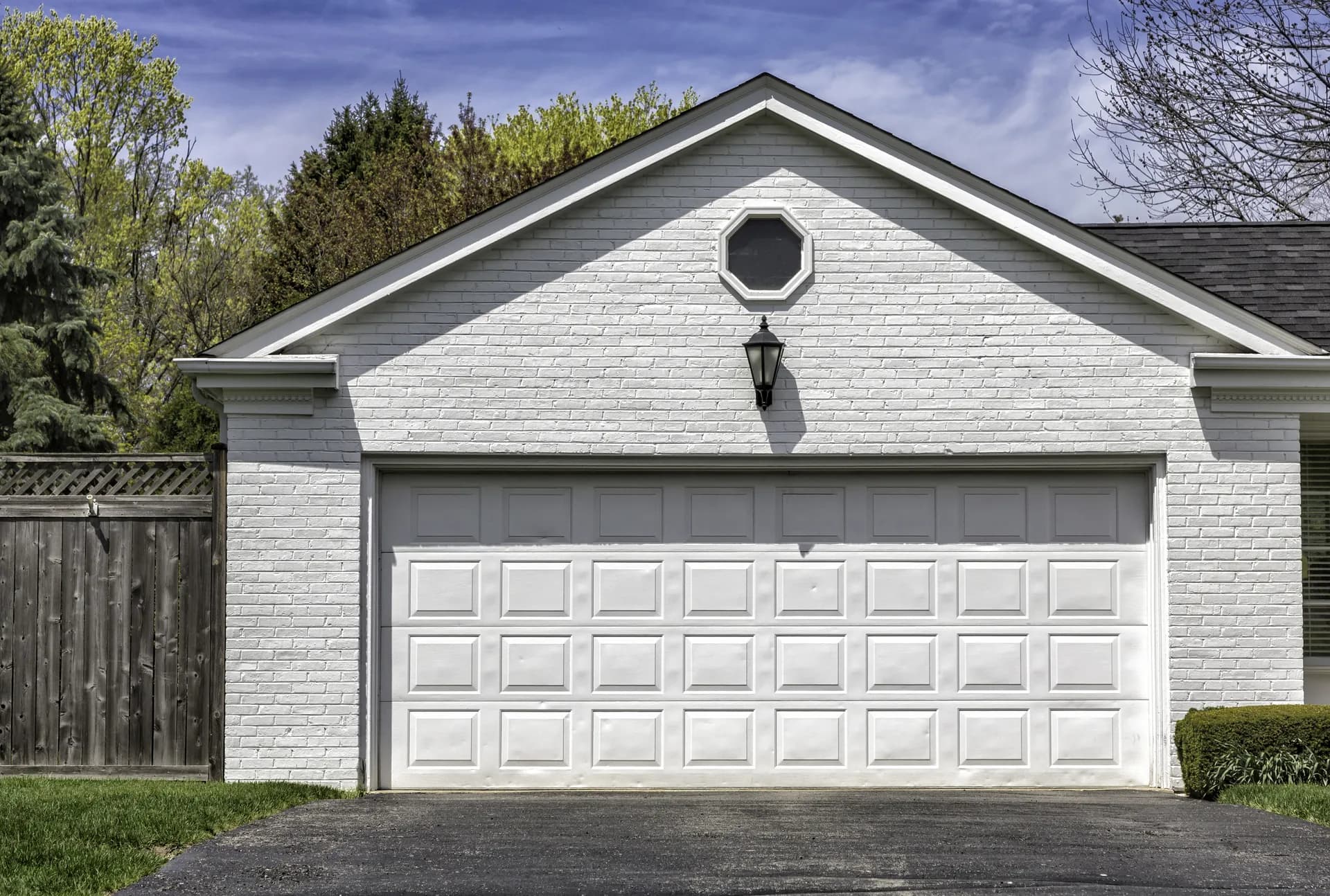
Take a walk to the end of your own driveway and look back at the house. On a city of roughly 59,000 people built out mostly as detached single-family housing, the elevation you are looking at breaks down into small openings and large surfaces: windows framed into walls, an entry door in a frame, a roof carried on a structure that ties into everything else, and then one enormous rectangle that is none of those things. The garage door is not framed into the wall. It is a set of hinged sections hanging in a hole, supported at intervals by rollers running in a pair of steel tracks, and free to move because moving is its entire function. Every other large surface on the front of the house is either braced by what surrounds it or is itself part of the structure. The door is neither. It is the only place on the building where a substantial area is held by a mechanism rather than by construction, and when the wind comes through hard it is the first thing on the elevation that has an opportunity to move.
The way the load arrives is the part people find counter-intuitive, and it is worth understanding because it changes what you look for afterwards. Wind does not simply push. Air moving across and around a building produces positive pressure on some faces and negative pressure — suction — on others, and a garage door recessed slightly into an opening can be on the receiving end of both, sometimes in quick alternation as the wind gusts and shifts. Suction is the one that does the damage. The door's rollers sit in tracks that hold it very well against being pushed inward, because inward travel is stopped by the track profile, the jambs and the stop moulding. Outward travel is held by far less: essentially the depth of the roller in its track and the grip of the brackets carrying it. So a door under serious suction is being pulled toward the street, and the failure, when it comes, is outward. That is why a door that has come to grief in wind is usually found bowed away from the garage, or with its top corner standing out of the track, rather than dented inward as everyone expects.
What resists that pull is a short and specific list, and it is worth knowing what is on it, because most owners have never been shown any of it. First, the struts — the horizontal reinforcing members that run across the back face of each section. Their number and their gauge decide whether a section behaves as a stiff plate or as a large flexible sheet that can bow through its middle and drag its end stiles inward, out of the track. Second, the gauge of the track itself, because a light track will deform locally around a loaded roller before anything else fails. Third, how many roller brackets are genuinely engaged and in good condition, since the whole outward load is fed through them one at a time. Fourth, and most often overlooked, what the vertical track is actually fixed to. Track lagged into solid jamb framing that is tied into the structure is one thing. Track screwed into cladding, into trim, or into a jamb board that is itself only nailed to the sheathing is another thing entirely, and from the floor the two look identical. The honest summary is that the standard residential installation is engineered for operation and not for wind load, which is a perfectly reasonable default and simply not the same thing as being braced.
The last piece is that wind damage is nearly always read as cosmetic, and that is the misunderstanding this whole page exists to correct. After a hard blow a door will very often still open and close, so nobody calls. What it has instead is a set of small signs: a section carrying a shallow bow across its middle that was not there last month; a top roller standing proud of its track, sitting on the lip rather than down in the channel; a strut fixing whose hole has gone from round to oval; hinge screws that have backed out a turn or two and now stand above the skin. None of those are blemishes. Each one is the door telling you that it moved as a whole and that the hardware absorbed that movement somewhere. There is also a delayed consequence in the counterbalance, which is dealt with in full on our spring page: a door that is briefly pulled outward can unload and then snatch its cables, and the resulting damage surfaces weeks afterwards, long after anyone would think to blame the weather. Which is the practical conclusion of all of this — after a serious wind event, the door is worth ten minutes of somebody looking at it properly, whether or not it is still working.
What we fix most often in La Habra
A section that has taken a shallow bow across its middle
Stand inside the closed garage, put your eye close to the door at one end and sight along the back face of each section in turn. A section that has been loaded hard will often show a gentle curve through its centre span, usually easiest to see on the widest sections of a double door. That bow is the section reporting that it flexed under pressure, and it matters for two reasons beyond appearance. A section that can flex through its middle pulls its end stiles inward as it does so, which reduces how far the rollers stay engaged in the tracks — the precise mechanism by which a door leaves its tracks in the next event rather than this one. And a bowed section no longer presents a flat face to its neighbours, so the hinge line between sections works at an angle it was not designed for. The remedy is usually strut work rather than a new section, and we will tell you which it is after looking rather than before.
A top roller sitting proud of its track after a windy night
The top roller on each side runs in an adjustable bracket, and it is the roller with the least engagement in the whole door because the track curves away there and the bracket is set to hold the top section against the header seal. It is therefore the first roller to be levered out of position when the door is pulled outward, and what you find afterwards is a roller stem sitting on the lip of the track rather than down in the channel, or a bracket whose fixing holes have gone slightly oval. People notice a new rubbing noise at the top of travel and assume the roller has worn out. Fitting a fresh roller into a bracket that has shifted puts the new roller in the same wrong place. We reset the bracket to the correct engagement, check that its fixings are into material that will still hold, and check the opposite side too, because whatever pulled on one corner pulled on the other at the same moment.
A dent from something the wind carried, and the bind it becomes
The second way wind damages a door has nothing to do with pressure. Strong offshore winds drive loose objects around, and a garage door is a large target that stands vertically in the open. A driven object arriving square-on leaves a dent, and the dent is almost never the actual problem. The problem is what the dent does to the section's geometry: the skin is locally deformed, which pulls the section very slightly out of plane, and if the deformation is anywhere near an end stile it shifts the roller's line of travel. What the owner then has is a door that has developed a catch at one particular height, on one particular side, dating from a specific week. That catch is a bind point, and every cycle from then on drives the roller, the hinge and the track edge against each other. Caught early it is a straightening and realignment job. Left alone it works its way into the hinges and the track.
Hardware that has quietly loosened rather than broken
The most common thing we find on a door that came through a wind event apparently unharmed is not a broken part but a set of loosened ones. Strut fixings with elongated holes. Hinge screws standing a turn or two above the skin. A track bracket whose lag has drawn back from the jamb far enough to show a shadow line behind the plate. End-stile fasteners that have worked in their holes. Each one on its own is trivial. Collectively they mean the door has less holding it in place than it had before, and the next hard blow starts from a weaker position than the last one did. This is cheap and quick to put right, and it is the single best argument for having a door looked at after a serious wind event even when nothing has visibly failed. Where a fixing hole will no longer hold cleanly, we relocate into sound material or span a backing plate rather than driving a longer screw into the same worked-out hole.
La Habra garage door FAQs
- It comes down to which technician is nearest to you when you ring, because that is who is sent. Our people work distributed across the service area rather than heading out from a single building, so the person answering the phone checks where the closest van actually is and builds a window from that and from the traffic between you. After a serious wind event the phones are busier than usual and the honest window is wider than usual, and you will be told which of those two situations you are in rather than being quoted an optimistic figure.
- It is worth looking at, and you can do the first part yourself in five minutes. Close the door, stand inside, and sight along the back face of each section for a bow through the middle. Then look at both top rollers and check each one is sitting down in its track channel rather than riding up on the lip. Then look along the struts and the hinges for fixings that have backed out or holes that have gone oval. If all of that looks right, the door probably rode it out. If any of it looks wrong, the door moved as a whole and something absorbed that movement, which is worth having somebody look at before the next blow rather than after it.
- It is a genuine option and we would rather frame it as a specification question than a product. Reinforcement generally means adding struts or upgrading the gauge of the ones fitted, improving the engagement and condition of the roller brackets, and making sure the vertical track is fixed back into real structure rather than into cladding or trim. Manufacturers also make doors and reinforcement kits specifically rated for wind load. Whether any of that is worth doing on your door depends on what is fitted now, and the honest position is that a great many doors in this area would benefit and most owners have simply never been told the option exists. We will tell you what you have, what the upgrade would consist of, and what it is worth on your particular door — including when the answer is that it is not worth it.
- A change in sound with no visible damage is usually a change in geometry, and after a wind event that is exactly what you would expect. A roller that is no longer sitting at its proper depth, a bracket that has shifted a few millimetres, a section with a new bow in it, or a dent near an end stile will all alter where the load is going without breaking anything. The useful detail to note before you call is whether the new noise happens at the same height on every cycle. If it does, it is a fixed geometric fault rather than a worn part, and that changes what the technician expects to find and what he brings in with him.
- Licensed, insured and bonded, and we will put that in writing for your records if you would like it. There is no charge for the diagnostic visit. We come out, inspect the door, show you physically what has moved or worn, and leave you a written estimate with parts and labour set out separately. If you want to think about it, or get a second opinion, that is entirely reasonable and there is nothing to pay.
Request service
Fast callback during business hours. For urgent safety issues, call now.