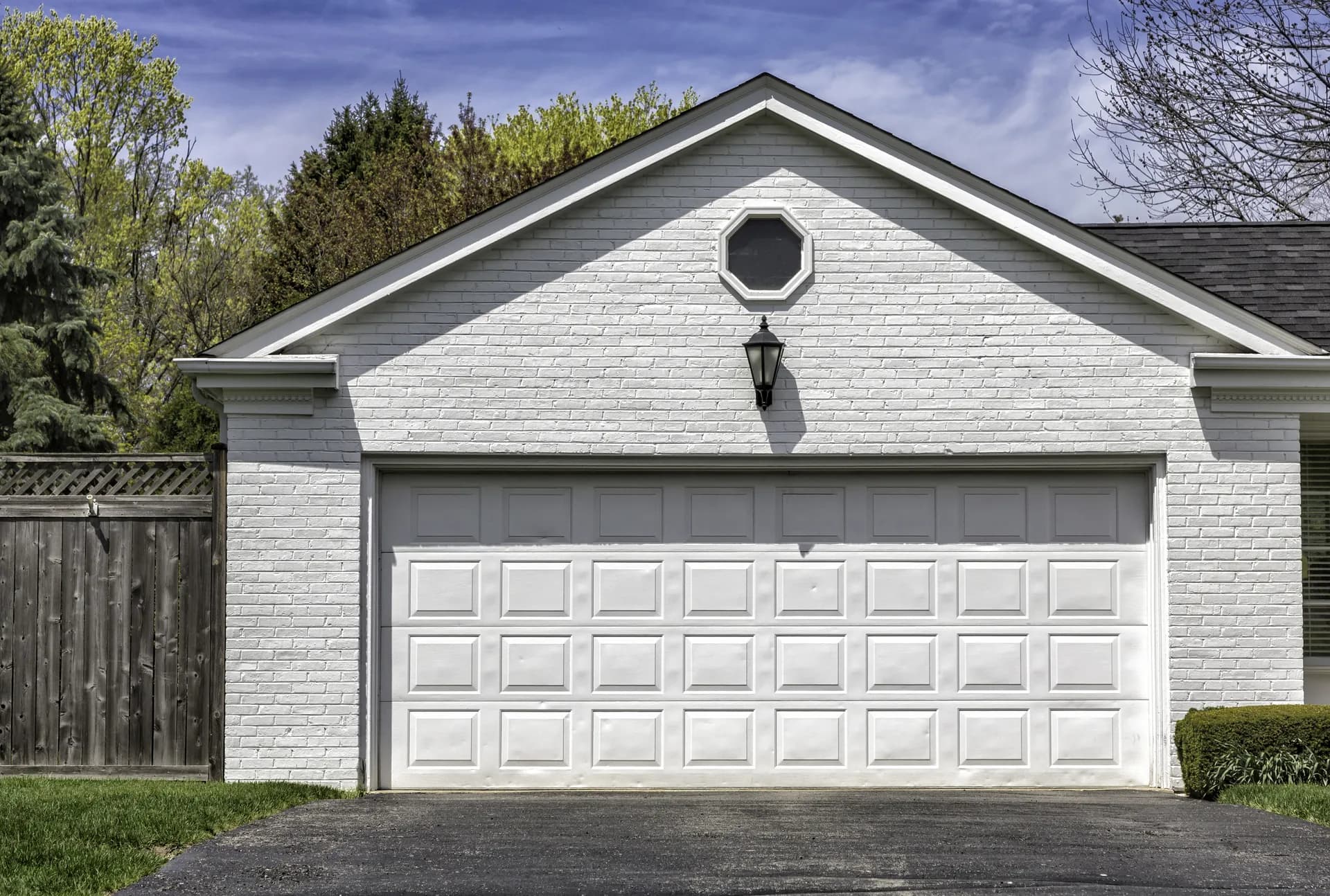
Downey Garage Door Repair
Wide Openings, Layered Sections, Connected Openers
Technicians working across Brea and Orange County — not dispatched from one address. Local routes via SR-57 and I-5.
Open 24/7 for emergencies
Free diagnostic estimate on every call-out
A garage door on a later-phase Brea house is not simply a bigger version of the door on a 1950s tract garage. It is a different machine. The opening is wider and frequently taller, the sections are built as a bonded sandwich rather than as a single formed pan, the counterbalance normally runs a pair of springs on one long shaft carried in the middle, and the operator overhead has a radio, a network connection and an account attached to it. Almost every step of the diagnosis changes with that, including which questions are worth asking on the phone before anybody sets off.
Those questions decide what goes on the truck. Our technicians work across this part of the county rather than starting the day at one address, so when you ring about a Brea address the person answering is looking at which of them is nearest to you at that moment and at what the SR-57 and the I-5 are doing in between. Behind the vans there is a working shop at 8232 Nance St in Downey with a genuine parts room in it — torsion springs racked by wire size and wound length, drums, bearings, cables, rollers and operator boards — which is why a van can leave loaded for a wide insulated door rather than for a generic residential one.
What the newer doors in Brea are actually built from
Brea holds a little under 38,600 people, and a meaningful share of its housing belongs to its later building phases, including the hillside ground where houses sit on graded pads. What that produces for this trade is a population of garage doors at the large end of the residential range. The openings are wider, they are often taller as well — a good number are sized so that a tall vehicle clears the header — and both of those dimensions add mass to something that has to be held in the air by a spring. A wider door needs a longer torsion shaft, which means more distance between the two bearings that support it. A taller door travels further, so every cycle unwinds more turns off the spring. And the track has to be a heavier gauge, because the same roller load is being carried on a longer, more flexible run of steel. On doors of this size, a higher-cycle spring specification is not an upgrade offered at the end of a sale. It is what the door should have been fitted with in the first place, and on a well-installed door it usually was.
The construction of the sections themselves is the part owners are least prepared for, and it changes what a repair can be. A modern insulated door is a sandwich: a formed steel outer skin, a polyurethane core foamed in place against it, and a steel back skin bonded to the other face. That assembly is far stiffer than a single-skin pan section of the same size, it is much quieter in the track because the core damps the drumming, and it holds its shape across a wide span instead of flexing in the middle. The consequence is the part worth knowing before you get an estimate. A single-skin steel section that has been dented can often be pushed and worked back into something acceptable, because it is one thin formed shell with air behind it. A bonded three-layer section cannot be, because straightening the outer skin does nothing to the crushed core behind it or to the bond between the two, and the section will never regain its original stiffness. A damaged multi-layer section is replaced rather than repaired, and that is a section-order conversation rather than a hand-tool one.
The other door type that turns up on newer construction here is the full-view aluminium-and-glass assembly: an aluminium frame carrying glazed panels across most or all of the door face. It brings its own set of rules. It is heavier again than an insulated steel door of the same size, so the counterbalance calculation moves once more. The glazing has to be specified rather than assumed — tempered, laminated, insulated, obscured, tinted and acrylic panels differ in weight, in how they behave when struck, and in what they do to the door's balance if a single panel is later swapped for a different type. And the frame is far less forgiving than a steel sectional. A steel door with a little flex in it will tolerate an opening that has gone slightly out of square; a rigid aluminium frame will not, and it announces the problem as a corner that stands proud, a stile that scrapes, or a bottom rail that meets the slab on one side before the other. On graded hillside ground where a slab or a stem wall has moved a fraction over the years, that intolerance is exactly what shows up first.
Then there is everything bolted around the door rather than in it. Newer operators here are commonly Wi-Fi connected, with phone notification, a camera in the head unit or on the wall, and in a fair number of houses an integration into an alarm panel or a smart-home hub that also holds the lighting and the locks. California requires battery backup on residential garage door operators installed in the state, so a new install has a battery in it whether or not the owner asked for one, and a battery is a consumable that eventually stops holding charge. All of this means the diagnostic on a modern door includes questions that never arise on an older unit: which network the head unit is on, whether the router was replaced, whether the account it is registered to still exists, whether the hub is sending a command the owner does not know about. It is worth saying the honest thing here rather than selling upward. More technology is more to go wrong, and a well-specified simple system — a solid door, correct springs, a plain reliable operator — will very often outlast a complicated one. Connected features are genuinely useful when you want them. They are not an improvement in reliability, and nobody should be told they are.
What we fix most often in Brea
A worn centre bearing on a dual-spring shaft
On a wide, heavy door the counterbalance is normally two springs on one long shaft, supported at the ends and again in the middle. That centre bearing is the part that decides whether the two springs work together. As it wears, the shaft no longer turns true through the middle of its run, and the two springs stop delivering their torque to their drums in phase — one drum leads, the other follows by a fraction of a turn. The door then lifts with a slight twist in it, and the twist grinds one side of the track and one set of rollers far harder than the other. The trap is that this reads as a spring problem. Springs get replaced, the door is fine for a week, and the twist comes back because nothing was done about the bearing that caused it. We check shaft runout at the centre before we accept any diagnosis involving these springs.
A damaged multi-layer section that cannot be straightened
The commonest disappointment on a modern insulated door is finding out what a dent actually costs. A three-layer section is an outer steel skin, a foamed polyurethane core and a bonded back skin, and its strength comes from those three acting as one piece. Once something has struck it hard enough to deform the outer skin, the core underneath is crushed and the bond between the layers is broken, and neither of those can be undone from the outside. Pulling the skin back to shape produces a section that looks better and is structurally softer than it was, which then flexes across a wide opening and works its hinges loose. The correct answer is replacing the section, matched to the door's model, profile and finish, and that is an order with a lead time rather than an hour's work. We would rather tell you that at the estimate than start hammering.
A full-view door meeting an opening that has moved
Aluminium-and-glass doors are rigid by design, and rigidity is exactly what makes them intolerant. The frame will not twist to accommodate an opening that is a little out of square, so any movement in the structure around it shows up in the door's behaviour rather than being quietly absorbed. What owners describe is a corner that no longer sits down on the slab, a stile that has started to scrape on one side, a door that seals along three edges and not the fourth, or a panel that has developed a rattle it did not have. On graded ground where a slab edge or a jamb has shifted over the years, the correction is at the opening and at the track geometry rather than at the door — packing the vertical track to plumb, resetting the spacing across the width, and adjusting the stops. Forcing a rigid frame to conform is how glazed panels get stressed.
Connected operators failing in software rather than hardware
A large share of the operator calls we take on newer doors turn out to have nothing mechanically wrong with them. The head unit has dropped off the network after a router was replaced or a band was renamed and the phone app no longer reaches it. A firmware update part-applied and left the unit in a state where the wall control works and nothing else does. The account the operator was registered to belonged to a previous owner. A smart-home hub is running an automation somebody set up two years ago and forgot, and the door is doing exactly what it was told. None of that is repaired with parts, and none of it should be billed as an operator fault. We separate the two early by testing the door on the hard-wired wall control alone, because if the door behaves perfectly there, the problem lives in the radio, the network or the account.
Brea garage door FAQs
- It depends on who is nearest to you at that moment, which is the only honest basis for an answer. Our technicians work across the service area rather than setting out from one building, so the person on the phone can see where the closest one actually is and builds a window from that and from what the SR-57 and the I-5 are doing between you. If the realistic figure is longer than you would like, you will be given the realistic figure. We would rather you planned around a number that holds.
- Almost certainly not in a way that leaves the door as strong as it was. An insulated door is a steel skin, a foamed core and a bonded back skin working as one piece, and an impact hard enough to deform the skin has already crushed the core and broken the bond behind it. Working the outer face back into shape improves the appearance and does not restore the stiffness, and a soft section on a wide door flexes and starts to loosen its hinges. The honest answer is usually a replacement section matched to the door, ordered rather than fabricated, and we will tell you the lead time at the estimate.
- That specific combination almost always points away from the opener's mechanics. The wall control is hard-wired to the logic board, so if the door runs correctly from it, the motor, the board's drive side, the travel limits and the safety reversal are all doing their jobs. What is broken is somewhere in the radio, the network or the account — a changed router or network name, a part-applied firmware update, an account registered to a previous owner, or a hub automation nobody remembers creating. We work through those before touching a part, and we will not sell you a new operator for a network problem.
- California requires battery backup on residential garage door operators installed in the state, so any new operator we fit here comes with one. It is worth understanding what it is for and what it is not. It exists so that a power cut does not leave somebody unable to get a vehicle out or a door open, which matters more on a wide, heavy door that is genuinely hard to lift by hand. It is a consumable: the cell loses capacity over years and eventually needs replacing, and the unit will normally tell you when it has. It is not a substitute for knowing where your manual release cord is.
- We are licensed, insured and bonded, and we will put those details in writing before any work begins if you want them for your own records. The diagnostic carries no call-out charge: a technician attends, finds the fault, physically shows you the component that failed rather than describing it, and leaves a written estimate with parts separated from labour. If you decide against the work, that is the end of it and there is nothing to pay.
Request service
Fast callback during business hours. For urgent safety issues, call now.