Downey Garage Door Repair
Buena Park: When the Replacement Door Wears Out
Technicians working across Buena Park and Orange County — not dispatched from one address. Local routes via I-5 and SR-91.
Open 24/7 for emergencies
Free diagnostic estimate on every call-out
Ring about a Buena Park address and the first thing the person answering does is establish which of our technicians is closest to you at that moment. Our people work out across the service area through the day rather than starting and finishing at one building, so the window you are quoted is built from where somebody actually is and what the roads between you are doing. Standing behind those vans is our own shop at 8232 Nance St in Downey. There is a genuine parts room inside it — springs racked by wire size, drums, bearings, cable lengths, track — which is the reason a van turns up loaded rather than turning up to look.
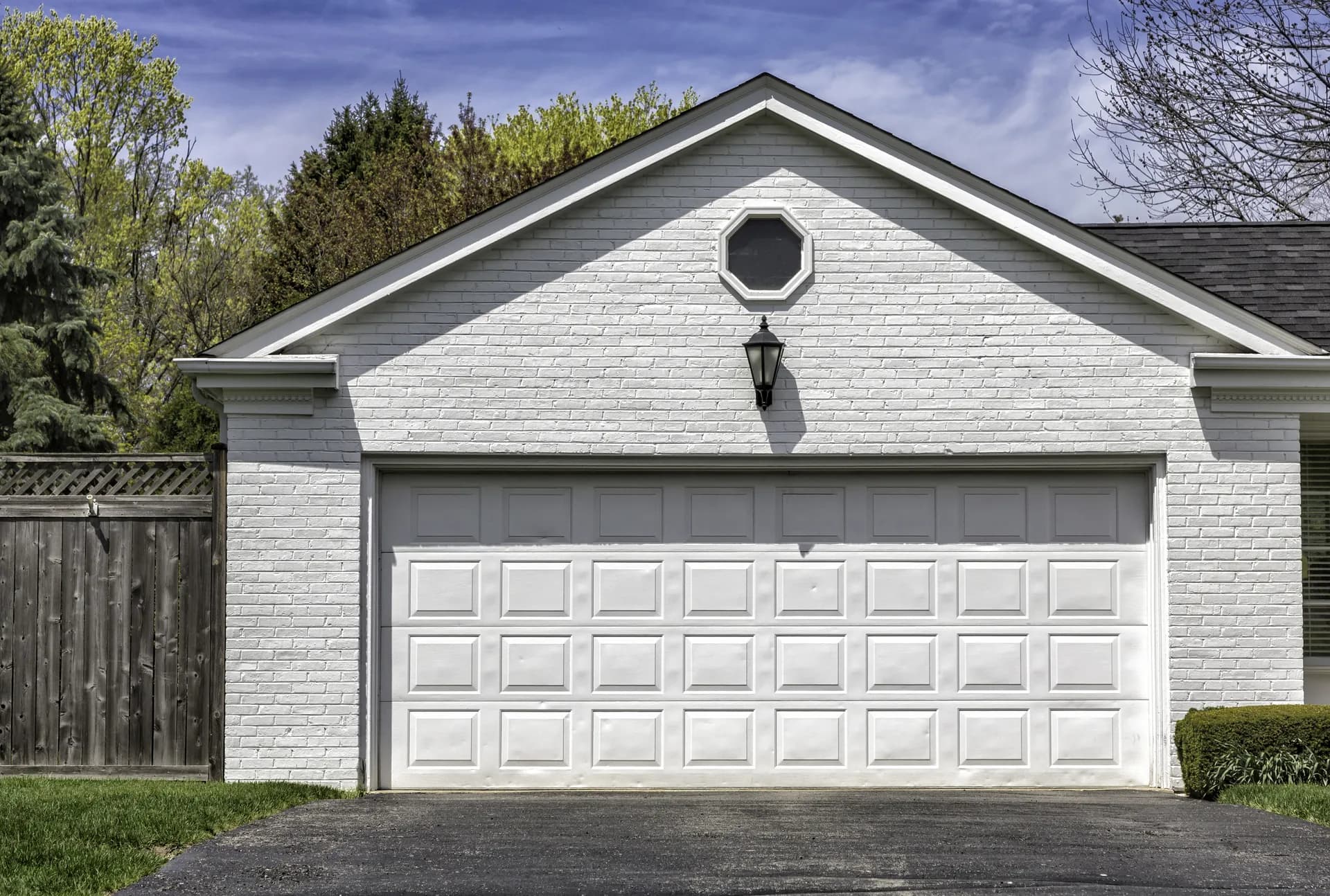
Buena Park sits at an unusual point on the calendar for this trade, and that is what this page is about. The housing here went up largely across the post-war decades, which means the door on your garage is almost certainly not the original one. It is the door that went in during the 1990s or the 2000s to replace the original, and that door is now fifteen to thirty years old in its own right. What fails in this city is the replacement rather than the thing it replaced, and knowing that changes what a technician looks for before the van doors are even open.
Why the door failing here is the second one, not the first
Work the dates forward and the position is straightforward. The bulk of this city's housing was built out through the post-war decades, and the doors hung on it at the time were the light one-piece tilt-up panels of that period — a single slab of timber or thin steel on jamb-mounted hardware, opened by hand, with no motor anywhere near it. Those doors had a long life but not an unlimited one, and across this city they came off within a fairly narrow window: roughly the 1990s into the 2000s, when the steel sectional had become both the default and cheap, and when an opener had stopped being an optional extra and become the assumed fitting. That wave of work is what we call the first replacement generation. A great many Buena Park garages are still running it, and it is now somewhere between fifteen and thirty years old.
What makes that useful rather than merely historical is how consistent those installations are. A replacement from that window is typically the same short list of parts: a steel sectional door, most often built from single-skin pan sections with no back skin and no reinforcing strut across the top; a torsion spring chosen at the cheapest acceptable rating for a door of that nominal size rather than derived from the door's measured weight; light two-inch track used as the house standard even on widths that warranted a heavier gauge; plain steel rollers running on unsealed bearings on short stems; and a chain-drive opener of the same vintage, its rail hung from whatever timber happened to be directly above it. None of that was wrong on the day it went in. It was ordinary, competently fitted, and specified to a price, which is a different thing from being specified to the door.
The consequence of a whole system going in on one day is that it comes to the end of its life on roughly one day too. Every component in that list started its cycle count at the same moment and has done the same number of openings since, so they age in step with one another. That is a different situation from a garage where parts have been renewed piecemeal across the decades — in that garage one item is tired and the rest have life in them. Here the assembly is old as a unit. The practical value is predictive: knowing what was in the box in 1998 tells a technician which component is nearest to letting go before he has looked at the door, and which three or four will follow it within a couple of years. There is nothing clever about it. It is just knowing what that generation of installation consisted of.
It also forces a conversation that most of the cities we cover do not require. Where one part has failed on an otherwise sound door, you repair that part, and nobody should be steering you anywhere else — that is a large share of the calls we take here and it stays a repair. Where several major components of one system are all genuinely at the end of their service life together, renewing one of them is treating a symptom, and you are better off hearing that at the first visit than working it out across the third. Neither answer is the default in this city. We argue it from component condition and measured remaining life, in whichever direction the door actually points. One administrative note while it is relevant: Buena Park is in Orange County rather than Los Angeles County, so anything structural — widening an opening, re-supporting a header — sits with a different authority than most of our work, with its own requirements and its own timeline. Repairs are unaffected either way. The I-5 and the SR-91 are how our technicians move around this city, which is a routing detail and not a statement about the clock.
What we fix most often in Buena Park
A spring that was specified down rather than up
The correct torsion spring is derived from three things: the weight of the door, the height it has to travel, and the diameter of the drums. What went on a great many doors in the first replacement wave was instead the cheapest spring in the range that would nominally lift a door of that size — the minimum acceptable rating rather than the measured one. It lifts the door, so it passes. It also sits closer to its own working limit on every single cycle than a properly derived spring does, and that shortens its life by a margin nobody can see until the day it lets go. The point is not that somebody was careless twenty years ago. The point is that fitting the identical part again simply repeats the interval, and re-speccing upward at replacement adds no labour at all, because the door is already open when we do it.
Two-inch track carrying a door that wanted heavier
Track is made in gauges, and the gauge is supposed to follow the width and mass of the door hanging in it. Light two-inch track was used as the standard fitting across the whole range in that period, including on double-width doors carrying real weight. Fifteen or twenty years of cycles later the symptoms are easy to recognise: vertical track that visibly flexes as the door breaks away from the floor, radius sections that have opened out where the door makes its transition, fixing holes at the jamb worn oval, and rollers wearing flat on one face because nothing is holding them true through the curve. Renewing the rollers on track in that condition is money spent on the consequence rather than the cause, and the new rollers wear out on the same schedule as the last set.
Pan sections with nothing keeping them straight
A single-skin steel section is a shallow formed pan: one layer of steel, no back skin, no core. That is perfectly serviceable in itself, but the section is only as stiff as its own shape, and the top section is the one that carries the opener arm — which loads it hard at a single bracket every time the door moves. Struts across the top section were an extra part, and in this generation of installation they were frequently left off. Twenty years on we find the top section bowed inward around the arm bracket, and occasionally the bracket beginning to pull its own fixings through the skin. It is not automatically terminal; a strut fitted now will often stop the bow progressing. But it has to be seen and dealt with before anybody bolts a stronger opener onto it.
An opener rail hung from whatever was overhead
The opener in these garages is usually the same age as the door, because both went in on the same morning, and the rail was hung from a post-war garage ceiling without much ceremony. What turns up is a rear hanger lagged into a single member that was never intended to take a repeated pulling load, sometimes a lag driven through a ceiling board that has been slowly working itself loose, and occasionally a fixing into timber that is not carrying anything structural at all. The tells are a rail that visibly shifts when the door starts to move and a hanger hole that has gone oval. The answer is to span onto sound framing rather than to drive a longer screw into a hole that has already failed once, and that is a modest job set against what happens when the anchor finally releases under load.
Buena Park garage door FAQs
- It comes down to which technician is closest to you at the moment you ring, and there is no more honest basis for an answer than that. Our people are spread through the service area instead of heading out from a single address, so whoever takes the call can see where the nearest van is standing and builds a window from that and from what the roads in between are doing. If the truthful answer is later than you were hoping for, that is still the answer you will be given. A window you can plan around is worth considerably more than one that sounded good while you were on the phone.
- There is something worth knowing, at least. A door of that vintage is normally running its original spring, its original track and often its original opener, all of which have done the same number of cycles. Nothing is wrong with it today, and we are not going to pretend otherwise. What is worth having is a look at the spring's condition and the state of the track and cables, so that you find out where you are on that curve while the door is still shut and working, rather than at the point where it is stuck open on a weeknight. If it has life in it, you will be told that and we will leave.
- It is a fair question and the honest answer is that it cuts both ways. A door where the sections are sound, the opening is square and only the counterbalance is finished should be repaired, and there are a great many of those in this city — we fit the spring, re-spec it properly, and that door has years left. What we will not do is stay quiet when the sections are bowing, the track has opened out, the cables are corroding at the bottom fixture and the spring is done, because renewing one of those in isolation leaves you paying for the next one shortly afterwards. You get the condition of each component in writing and the decision stays yours.
- On the condition of the parts and the life left in them, item by item, and on nothing else. We weigh the door, check the spring against what it should have been specified at, look at the track gauge and its wear, inspect the cables end to end, check the sections for distortion around the bracket points and the hinges for elongation, and assess the opener against the weight it is being asked to move. What comes out of that is a list with a condition against each line. When most of that list still has service in it, the answer is repair, and that is what we will tell you. When most of it does not, you deserve to hear that in the same plain terms.
- We hold a licence, we carry insurance and we are bonded, and all of that can go to you in writing before anything starts if you want it on file. There is no call-out fee for the diagnosis: a technician attends, establishes the fault, hands you the component that failed, and leaves an estimate on paper with the parts set out separately from the labour. Decide against it and you owe nothing, with no argument attached. If what you are asking about is structural rather than a repair, you will also hear at that point that it runs through Orange County rather than Los Angeles County, and what that means for the dates.
Request service
Fast callback during business hours. For urgent safety issues, call now.