Downey Garage Door Repair
Garage Door Opener Repair in West Covina, CA
Opener Repair in West Covina, Los Angeles County. Technicians work across the area, so when you call we send whoever is nearest to you.
Open 24/7 for emergencies
Free diagnostic estimate on every call-out
Opener faults sort into four piles: nothing happens at all, the motor runs but the door does not move, the door starts to close and changes its mind, or the door moves perfectly well but something in the entry system — a remote, a keypad, a wall control — has stopped being reliable. The last two piles are the biggest here, and both are usually far cheaper to put right than the owner fears.
West Covina complicates the second pile in a way that is worth reading before you agree to a new unit. On a wide door, a straining motor and a door that will not move is very frequently not an opener fault at all. It is the door failing where the opener is bolted to it, and it gets paid for as an opener about as often as it gets diagnosed correctly.
The most common opener fault here is not an opener fault
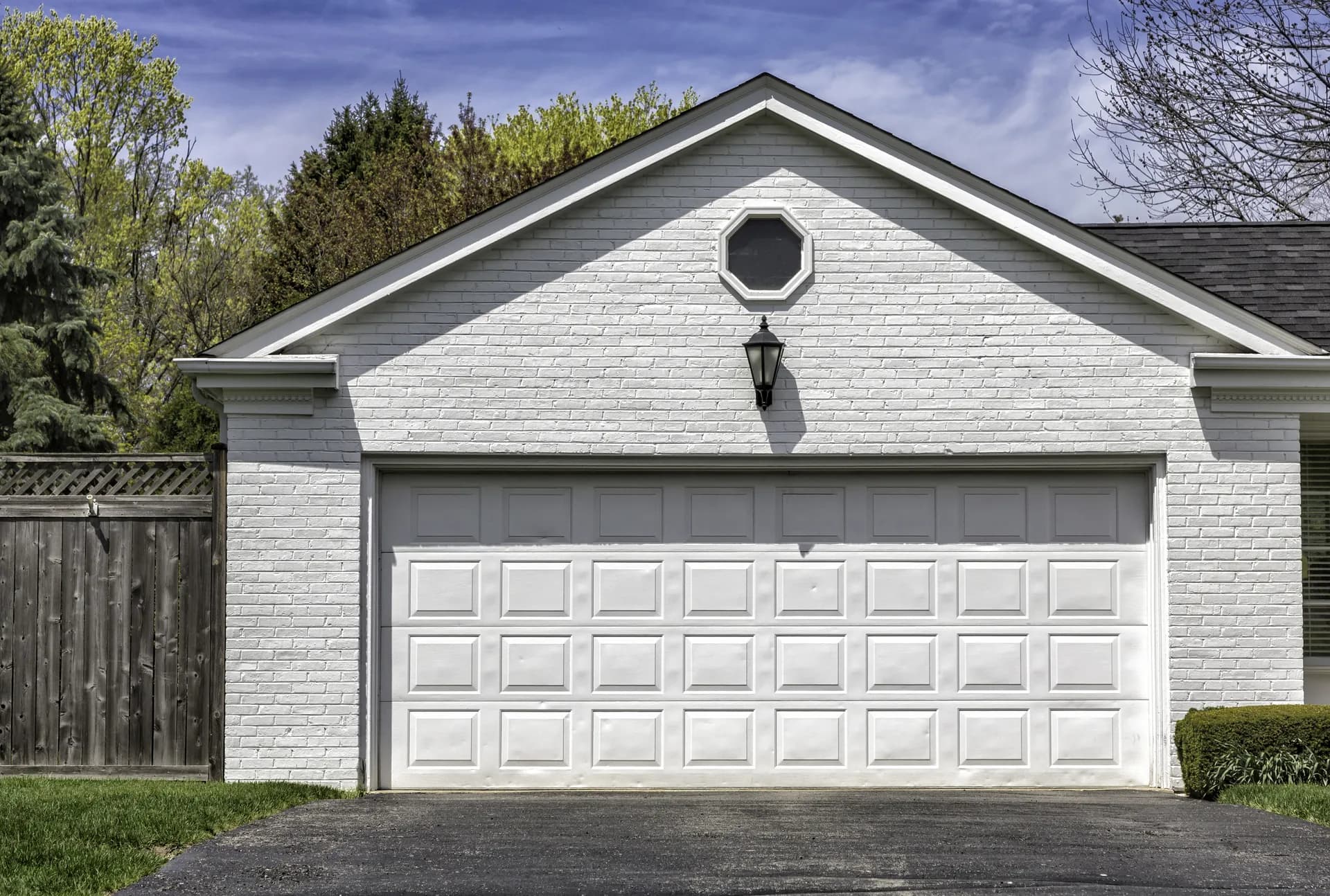
An opener does not pull a garage door. It pulls a single bracket bolted to the middle of the top section, and the top section is then expected to distribute that load across its whole width, out to the end stiles and down through the hinges into the sections below. On a narrow door that is an unremarkable demand. On a sixteen or eighteen foot door, it means asking a formed steel panel to act as a beam over eight feet of unsupported span in each direction, while carrying the initial break-away force needed to get a heavy door moving, several times a day, for years.
It fails in a recognisable sequence. First the skin around the bracket begins to dish — a shallow dimple you would not notice unless you were looking for it. Then the bolt holes elongate from round to oval and the bracket starts to move minutely under load, which you can sometimes hear as a knock at the start of travel. Then the top section itself takes a permanent bow, so the door no longer meets the header squarely and starts to lag at the top of travel. Finally the bracket tears through, either pulling the fasteners out or punching a hole in the panel. At any point in that sequence the presenting symptom is a motor that strains and a door that will not go, which is indistinguishable from the driveway from a dying opener.
The fix is a strut: a length of steel channel bolted horizontally across the full width of the top section, engaging the end stiles, plus a reinforcement plate behind the operator bracket where the panel has already been worked. It converts the section from a sheet into a beam and spreads the opener's pull out to the whole door. It is not exotic and it is not expensive relative to an opener. Most builder-specification wide doors simply leave the factory without one, because the door works perfectly well without it for the first few thousand cycles and it is a line item somebody removed. Where the panel is already torn rather than merely dished, the section itself has to be replaced and then strutted — reinforcing a torn panel is a repair that comes back.
There is a compounding factor worth naming, because it is the thing that turns a slow problem into a fast one. If the door's balance has drifted — springs past their best, cables taking up unevenly, rollers binding — the door gets heavier to start, so somebody winds up the opener's force setting to make it close and open reliably again. That extra force goes through the same single bracket. Every force adjustment made to compensate for a mechanical problem elsewhere is paid for by the top section, which is why we check balance before we touch a force setting, and why an opener whose force has clearly been wound up is a reason to go and look at the door rather than the motor.
When the motor genuinely is the problem
A motor that hums or spins while the door stands still has usually lost the teeth off its main drive gear — the nylon one meshing with the steel worm on the motor shaft. That is a serviceable part on all the major brands, sold as a gear and sprocket set, and those sets ride on the van. Fitting one and departing, however, is not a repair we are prepared to call finished, because a chewed gear is far more often evidence than cause. Two years spent dragging a door whose counterbalance is past its cycle life, or fighting a top section that has started to bow, will consume the replacement gear on exactly the timetable that consumed the original. A force setting somebody has been winding up over the years is the giveaway, and confirming it takes a few minutes with the door uncoupled.
Rails and trolleys are the second genuine mechanical failure, and wide doors are hard on both. Chains stretch, belts lose tension, the trolley carriage wears at its rail contact, and the whole assembly starts to slap and shudder at start-up — which on a heavy door is the exact moment the highest load of the whole cycle arrives. Re-tensioning genuinely buys time and is worth doing. Once the rail itself has worn, though, the real choice is between repeating that adjustment indefinitely and fitting a new drive assembly, or moving to a belt, which settles it. On a door this wide there is a further thing worth confirming: that the unit's rated capacity actually corresponds to the door it is being asked to shift. An underspecified opener on a heavy door is a machine operating at its ceiling on every single cycle.
Then come the electrical faults that routinely get blamed on the wrong component. A capacitor on the way out presents as a motor that hums and labours to get moving, most obviously once it has been running a while. A logic board that has taken a spike off the supply misbehaves rather than dying outright — instructions ignored, unprompted resets, a light that dips. And plenty of these garages run the opener on a circuit it shares with a freezer, a washer and dryer, and whatever else has accumulated over the decades, sometimes by way of an extension lead somebody intended to be temporary a very long time ago. Brownout under starting load imitates a dying board convincingly, and no new opener will repair a supply that cannot deliver. Where that is the finding, you will be told what genuinely needs addressing, even though it is not work we are quoting for.
Sensors, and the door that stops an inch short
Photo-eyes have been mandatory equipment on residential openers since federal rules brought them in at the start of the 1990s: one each side of the opening, mounted low, holding an infrared beam across the threshold. Interrupt that beam during a close and the opener must halt the door and send it back up. The rule is a good one and it prevents real harm. Its side effect is that anything obstructing or misaligning the beam presents identically — a door that declines to close and volunteers no reason why. Recycling bins, a bicycle wheel, the corner of a workbench, a sack of dog food, the flank of a car parked a little wide in a two-car bay. The eye brackets occupy precisely the strip of floor a busy garage uses for putting things down, and a wide opening simply offers more of that strip on either side.
Wiring accounts for the other half, and a wide door has more of it, since the low-voltage run has to reach right across a broader opening. Almost always it is a retrofit, stapled along the wall at skirting height, and one staple driven a shade too firmly through the insulation yields an intermittent short that surfaces and vanishes over months. Replacing the eyes appears to cure that for a fortnight or so. Continuity gets tested along the entire run here rather than parts being changed speculatively, because arriving at a wiring fault that two previous visits have already misread is a common enough history on these calls.
The fault that matters most in this city, though, is subtler than either. Something makes the door stop or reverse just before it seats — an eye a fraction out of alignment so it clips near the end of travel, a close-force or down-limit setting that has drifted, a roller binding in the last few inches, a bottom seal hardened enough that the opener reads the resistance as an obstruction. The door comes to rest an inch or two off the slab. It looks shut from the street. The seal is not compressed and the door is not seated, so the house is standing open behind something everybody assumes is closed. We chase the actual cause of that rather than winding up the close force until the door stops complaining, because winding up the force to defeat an obstruction sensor is defeating the sensor, and the load that increase creates goes straight back into the top section.
Remotes, keypads and monitoring when the garage is your front door
In a house where the garage door is the entrance, the entry hardware is not a convenience layer, it is the lock on the front door, and it deserves to be treated that way. Remotes made before rolling-code encryption became standard transmit a fixed code every time, and a fixed code can be captured and replayed by equipment that is not hard to come by. Plenty of those units are still in service on doors that are otherwise in fine condition. If your opener predates rolling code, that is a genuine security consideration rather than a sales angle, and where the mechanics are sound it can often be addressed with an external rolling-code receiver rather than a whole new unit.
Exterior keypads live outdoors and age accordingly. The membrane hardens and splits, water finds the battery compartment and corrodes the contacts, and after enough years the keys that are actually pressed are visibly more worn than the ones that are not — which narrows the guessing considerably for anybody who looks. A keypad is a cheap part and changing the code periodically costs nothing, and both are worth doing on a door that is used the way these are. While we are on security: an emergency release cord left hanging within easy reach of a gap at the head of the door is a well-known weakness, and it is addressed with a shield or by shortening and re-routing the cord so the release still functions from inside.
Position monitoring earns its place here for one reason, and it is worth being precise about what it does and does not do. A door that refuses to close tells you about itself immediately. A door that stops an inch short does not, and that is the failure that leaves a house open. A position sensor closes that blind spot by telling you the door is not closed, and an unattended-close function will shut a door that was genuinely left open by mistake. Two honest caveats. A compliant unattended close warns before it moves the door rather than closing silently, which is a safety requirement and not a defect. And a tilt sensor mounted on the top section reports the section's angle, not whether the bottom seal has seated — so a door stopping an inch short can still report as closed. Monitoring is a very good early warning. It is not a substitute for fixing the reason the door is not seating.
Finally, battery backup, which in this city is less of a luxury than it sounds. If the garage door is how the household gets in and out and how the cars get on and off the drive, a power cut with the door shut means the cars are stuck and the manual release is the only way in — and on a wide, heavy door, hand-hauling it is a genuinely two-person job. A backup unit rides the outage and keeps the entrance working. If you are replacing an opener anyway, fitting one costs very little extra at that point and is awkward to retrofit later.
Opener Repair in West Covina — FAQs
- Usually the photo-eyes, and usually one of four things: a bracket knocked off aim, a lens gone cloudy, a break in the low-voltage run that comes and goes, or an object sitting in the beam that has occupied that spot so long it has become furniture. Before ringing anyone, go and look along the floor at both sides of the opening — a decent share of these calls end with somebody moving a bin. What remains is generally a close-force or down-limit setting that has drifted, a roller binding over the final few inches, or a bottom seal hardened enough that the opener reads it as something in the way. None of that warrants a new motor, and none of it should be answered by turning the force up.
- Have somebody look at the top section of the door before you buy one. On a wide door with no strut across that section, the panel dishes and bows around the operator bracket and eventually tears out, and the symptom is exactly this — a motor working hard against a door that will not go. If that is the fault, a new opener does not fix it and gets damaged in turn. The real repair is a strut across the top section, a reinforcement plate behind the bracket, and a section replacement if the panel is already torn. We check the door before we form a view about the motor.
- Shrinking range is the classic signature of a weakening receiver on the logic board, and it is worth distinguishing from a flat remote battery, which is the other common cause and takes a minute to rule out. Try a fresh battery and re-pair the remote first. If range is still poor from more than one remote, the receiver is the likely culprit — and on an older unit that has to be weighed against its age, since a fixed-code opener is worth replacing or fitting an external rolling-code receiver to on security grounds anyway. We carry programmers for the major brands, so pairing and range issues are normally settled on the visit.
Other garage door services in West Covina
Request service
Fast callback during business hours. For urgent safety issues, call now.